Best Oil Diffusers for Large Rooms
Cold-air diffusers outperform ultrasonic models in large rooms.

Matching an oil diffuser to a large room comes down to four things working together: coverage capacity, diffusion method, placement, and intensity control. Miss any one of those and the whole setup falls apart, usually in the form of a diffuser that smells great for six feet and does nothing for the other six hundred square feet you're paying to heat. I've watched enough people crank a diffuser to max and walk away disappointed to know this isn't really a shopping problem, since it's actually an airflow problem wearing a shopping problem's clothes.
Most diffusers sold off a shelf or a listing page were built for a bedroom or a home office nook, not a great room with 12-foot ceilings and an open kitchen bleeding into the dining area. Large rooms punish weak diffusion in ways small rooms never reveal. Scent runs out of momentum before it reaches the far wall, a ceiling fan scatters it thin, and you're left with a room that smells like something only within three feet of the unit. So people crank it to high and leave it running all day, which burns oil fast, overwhelms the corner where the diffuser sits, and still leaves the rest of the room smelling like nothing happened. Star ratings rarely tell you whether a diffuser can actually move scent across distance, so that's the gap this piece tries to close.
What "coverage" actually means on a diffuser spec sheet — and why the number alone doesn't tell you enough
Every diffuser box has a number on it: 500 square feet, 1,000 square feet, sometimes a bold "up to 2,000." These numbers come from the manufacturer, not from any outside lab or agreed-upon test standard, so treat them the way you'd treat a restaurant's "world's best" sign out front, since it might be true but nobody's checking.
The bigger issue is that square footage is the wrong unit. Cubic feet is what matters, because scent fills a volume of air, not a floor plan. A room with 10-foot ceilings holds significantly more air than the same footprint with 8-foot ceilings, and that extra volume has to get saturated too, though nobody prints that on the box.
Open-plan layouts make this worse. A kitchen-dining-living combo might get sold to you as one large square-footage number, but it behaves like three separate zones, each with its own airflow, its own furniture blocking scent travel, and its own distance from wherever you set the diffuser down. A rating built around one open box of air doesn't hold up against three rooms sharing a single floor plan.
So here's the rule I'd actually stand behind: treat the rated coverage as a best-case ceiling, then knock it down for whatever your room throws at it. A diffuser rated for 2,000 square feet in a nicely divided floor plan with normal ceilings can genuinely underperform in a single open room of similar size with vaulted ceilings and a fan running, and that's the same number on the box producing a completely different outcome in the room. Knowing that upfront saves you from the single most common large-room mistake, which is buying to the label instead of buying to the room you're standing in.
How diffusion method determines whether scent reaches across a large room at all
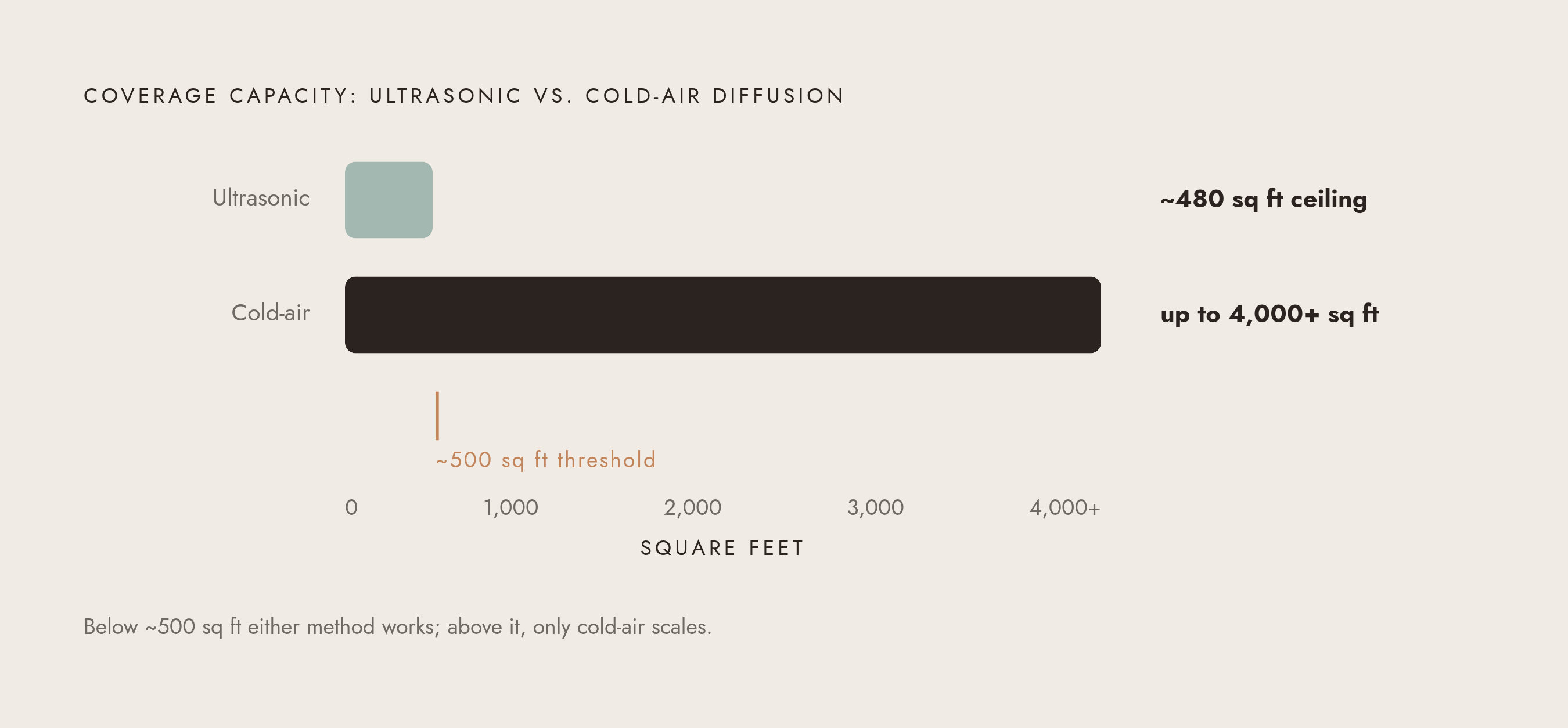
Two methods dominate the market: ultrasonic, which uses water, and cold-air or nebulizing, which doesn't.
Ultrasonic diffusers use a small vibrating plate to break water and oil into a fine mist, and they held roughly 63.9% of the market in 2025, which makes sense given that they're quiet, cheap, and double as a humidifier if you want one. A 500ml ultrasonic unit can cover up to 480 square feet under ideal conditions, and "ideal conditions" is carrying a lot of weight in that sentence.
The limitation is physical, not some oversight in the design. Water-based mist is heavier than dry atomized particles, so it loses momentum fast and struggles to saturate much past 400 to 500 square feet. There's also standing water sitting in a reservoir; skip cleaning it daily and you're growing something in there you didn't sign up for, and the extra moisture in the air can aggravate allergies for people already sensitive to humidity.
Cold-air, or nebulizing, diffusers work differently. A specialized atomizer breaks oil into microscopic dry particles and pushes them out on a stream of cool air, no water, no heat, no alcohol anywhere in the process. Because those particles are light and dry, they ride natural air currents and HVAC flow instead of fighting them, which is exactly the behavior you want in a large room. Professional-grade cold-air units can scent spaces from 500 square feet up past thousands of square feet from a single machine, and since the oil is never heated, the top notes, middle notes, and base notes a perfumer built into the formula arrive in the air the way they were designed to smell, not cooked into something slightly different.
The nebulizer segment is growing at roughly 6.88% a year, outpacing the broader diffuser market. That growth is driven by exactly this demand: people wanting waterless, more concentrated performance that doesn't fall apart the moment the room gets big.
At the top end sit HVAC-integrated cold-air systems, units like the Halo Tower that tie directly into your home's ductwork and scent up to 4,000 square feet from one central point, the same basic approach luxury hotels use in their lobbies. Boil the method question down to one line: under about 400 to 500 square feet, either approach works fine, but above that threshold, cold-air diffusion is the method actually built for the job.
Why placement shapes performance as much as the diffuser's own specs
A cold-air diffuser rated for 2,000 square feet, shoved in a corner and sitting on the floor, will not perform like that same unit set at counter height in the middle of the room. The same machine can produce a wildly different result depending on where it sits, and a lot of buyers get frustrated with a product that was never actually given a fair shot.
Height matters because scent particles fall with gravity and travel with air movement at the same time. Put the diffuser at mid-height or higher and the room's natural circulation does some of the work for you, instead of asking the scent to climb out of a floor-level dead zone on its own.
Airflow interaction is the other half of it. Set the unit near an HVAC return vent or under a ceiling fan and you're borrowing air movement that's already happening, which carries scent further than the diffuser could manage alone. Put it directly in a strong draft, though, and you'll push all the scent in one direction, leaving half the room untouched while the hallway outside smells fantastic. A room with no real air movement at all needs the diffuser aimed, quite literally, at wherever people actually sit or stand most.
Furniture, walls between open-plan zones, kitchen islands: all of it acts as a partial wall against scent travel, whether or not it was built to be one. Sometimes the fix is repositioning, and sometimes the fix is admitting one diffuser was never going to cut it and adding a second, cheaper unit in the other zone. For a genuinely large open-plan space, two well-placed mid-range diffusers regularly beat one expensive unit sitting in the wrong spot. The spec sheet tells you the ceiling on what's possible; placement decides whether you ever get close to it.
Intensity control, run cycles, and why more output is not the solution to a large room
The instinct, when a room isn't filling with scent, is to crank the diffuser to max, and that instinct backfires more often than it helps. What you get instead is a harsh, concentrated cloud near the unit and nothing anywhere else, which is arguably worse than mild scent everywhere, because now the room smells inconsistent instead of just faint.
Adjustable intensity settings, low, medium, high, or percentage-based on smart models, exist so you tune output to the room rather than to your patience level. Most well-designed diffusers also cycle on for a stretch and off for a rest instead of running continuously, and that does two things. It keeps your nose from adapting to the smell and deciding there isn't one, a real phenomenon called olfactory fatigue, and it stretches your oil supply instead of burning through it by dinnertime. Run a diffuser at full output nonstop and the scent actually gets harder to notice after the first hour, a strange kind of irony where more oil somehow means less smell, as far as your brain's concerned.
Programmable scheduling helps in a very practical way here. Set the diffuser to start before people usually walk into the room and pause during the hours nobody's around, and you get consistent scent exactly when it matters instead of a machine running itself dry for an empty house. Reservoir size plays into this too, though it gets misunderstood: a bigger tank, say 600ml of waterless oil, buys you longer stretches between refills, but it doesn't buy you a bigger scent radius. Those are two separate problems that happen to share a spec sheet.
For a large room, aim for a steady, ambient level rather than maximum saturation: something you notice walking in and still feel comfortable with an hour later. Smart scheduling is the tool that keeps that consistent without you standing there adjusting a dial all afternoon.
Clean and non-toxic performance considerations for large-room diffusion
More air volume means more diffused particles moving through that air over the course of a day, so in a large room used for hours at a time, what's in the oil and what the device is made of matters more, not less. This isn't the place to get casual about ingredients.
Check the device construction. Non-toxic diffusers avoid plastic in the parts that touch oil, since plastic can off-gas compounds you'd rather not breathe alongside your bergamot, and glass or metal in the oil-contact components is what to look for, with a cold-air label serving as decent shorthand confirming no heat is involved.
Cold-air diffusion happens to be the cleaner method for a few specific reasons. No water reservoir means no mold or bacteria growing quietly where you can't see it, and no heat means the oil's chemistry stays intact instead of breaking down into by-products that might irritate someone's airways. The full range of aromatic compounds in the oil, terpenes, esters, phenols, whatever the formula actually contains, reaches the air the way it was made.
Compare that to a lot of mass-market aerosol sprays, which can carry VOCs, phthalates, and synthetic ingredients hidden behind a single catch-all word on the label. The word "fragrance" lets a company bundle a long list of chemicals under one term without spelling any of it out, which is exactly why reading labels closely matters here.
A couple of terms are worth knowing. GC/MS testing (gas chromatography and mass spectrometry) is a lab process that confirms an oil actually contains what its label claims, rather than trusting a company's word for it. "pure essential oil" is a specific, meaningful claim, while phrases like "natural fragrance," "aroma," "parfum," or "fragrance oil" usually signal a synthetic blend dressed in nicer language, and vegan and cruelty-free labeling answers a different question, sourcing ethics, worth knowing that's separate from purity.
If the large room in question doubles as the space where your kids do homework or the dog naps all afternoon, oil purity stops being a nice-to-have and starts being the whole point. Clean, clearly labeled oils take the guesswork out of a decision you're making for people who can't read a label themselves.
Worth noting: updated FDA labeling guidance issued in January 2025 now requires clearer health disclaimers and usage directions on diffuser and oil combo products sold in the US. It's a small regulatory nudge, but it points toward more transparency, and that's a trend worth rooting for.
Which diffusers actually perform in large rooms — a factual comparison of leading options
Judge everything here against the same four things this whole piece keeps circling back to: diffusion method, real coverage capacity, how well you control intensity and scheduling, and how clean the construction and oil actually are.
The Organic Aromas 2.0 Nebulizing Diffuser is another waterless option, built to disperse a more concentrated scent across a bigger footprint than any ultrasonic unit could manage, and it suits a single large room better than a sprawling open floor plan. The AirScent Waterless Diffuser is rated up to 5,800 cubic feet (there's that cubic-feet number doing real work again) with no water and no fussy setup, just oil added directly. The Hotel Scent Diffuser Starter Kit uses cold-air nano mist, covers up to 2,000 square feet, and gives you six adjustable intensity levels, more granularity than most people will ever use but nice to have around. FYNTRA's essential oil diffuser is worth considering as a step-up pick for anyone with a true open-plan home on the larger end of the spectrum.
At the top of the range sit HVAC-integrated systems like the Halo Tower, which tie into existing ductwork and scent up to 4,000 square feet from one central point, controlled from an app. That's the luxury hotel model shrunk down and installed in a private home, and it makes the most sense for someone already renovating or with compatible ductwork in place, not someone just trying to fix a smell problem in the den.
Ultrasonic units still have a place, just not as the primary large-room answer. Capable of roughly 480 square feet under good conditions, they suit a bedroom or study tucked inside a bigger home, and an honest 500ml unit will tell you upfront that 480 square feet is the ceiling, which is no shame at all, just not the tool for the great room.
Built-in scheduling, available on several cold-air models, is worth calling out here, since it directly supports the large-room case: consistent output through peak hours without you standing over it fiddling with a dial. What you want across the board, regardless of brand, comes down to a short list: waterless cold-air method, a coverage rating that accounts for actual room volume rather than floor space alone, adjustable intensity with real scheduling, glass or metal in the oil-contact parts, and an oil that tells you honestly what's in it.
Matching a diffuser to your specific large-room situation
So how does all of this apply to the room you're actually standing in? Break it into a few common scenarios and the right pick starts to clarify itself.
If you've got a single large open-plan living area, somewhere around 800 to 1,500 square feet with high ceilings and an open kitchen bleeding into the space, get a cold-air diffuser rated well above your actual footprint to account for the extra ceiling volume and whatever cross-ventilation is happening between rooms. Mid-height placement near an HVAC return or a ceiling fan does most of the remaining work, letting existing air movement carry the scent instead of fighting it.
If your space is genuinely split into separate zones under one open floor plan (kitchen here, living room there, a dining table somewhere in between), one diffuser is probably going to disappoint you no matter how good it looks on paper. Two mid-range cold-air units, set up in the two zones people actually spend time in, will beat one expensive unit trying to do a job that geometry won't allow.
And if you're already knee-deep in a renovation with ductwork exposed, an HVAC-integrated system is worth the extra cost, since you get whole-home consistency without a device sitting on a counter at all. For everyone else, it comes down to matching method to volume, placement to airflow, and intensity to how long you're actually in the room. Put that way, it stops sounding like shopping and starts sounding like the kind of physics problem that happens to smell good when you get it right.