VOC Emissions Comparison Between Diffuser Types
Natural fragrance constituents trigger unexpected chemical reactions in home air.

Let me be honest about something before we begin: when I started working in home fragrance, I thought the health conversation around diffusers was largely performative. Candles seemed obviously worse than reed diffusers, reed diffusers seemed obviously safer than candles, and cold-air nebulizers seemed like the obvious answer for anyone anxious about air quality. The hierarchy felt intuitive. The problem is that "intuitive" and "defensible" are different standards, and once you actually examine the emission chemistry across diffuser types, the picture gets meaningfully more complicated.
The market context makes this worth examining rigorously. Grand View Research values the home fragrance category at $13.2 billion in 2025, projected to reach $26.5 billion by 2033. Those numbers represent an enormous number of households diffusing something continuously, daily, as part of wellness and ambiance routines. The exposure pattern that matters isn't the occasional dinner candle — it's cumulative, low-level VOC inhalation across years. The EPA's finding that indoor air is often two to five times more polluted than outdoor air isn't a scare statistic; it's an orientation device that tells you where to look.
This article's job is to give you the science to rank each major diffuser technology by VOC emission profile so you can make a calibrated choice.
Volatile organic compounds are not all created equal, and the delivery mechanism is why that matters
Volatile organic compounds are gases that vaporize into indoor air at room temperature from liquids and solids, including the fragrance compounds in every product discussed here. That definition is correct and also somewhat misleading, because it lumps linalool from a lavender oil and benzene from burning paraffin into the same taxonomic category. The toxicological distance between those two molecules is significant.
Naturally derived VOCs like linalool and α-pinene have different health profiles than combustion-generated VOCs like benzene and formaldehyde. Concentration, duration, and ventilation determine whether any given VOC level constitutes a health concern.
The distinction most product comparisons overlook is primary versus secondary emissions. Primary emissions are VOCs released directly from the fragrance oil or from the combustion process. Secondary emissions occur when diffused primary compounds react with ambient ozone already present in your home air. Linalool and α-pinene, both common fragrance constituents, can react with ozone to generate formaldehyde and ultrafine particles, potentially more harmful than the original molecules. The ingredient label does not tell you this. The secondary emission risk is structural, not incidental, and it applies across every diffuser format to varying degrees.
Delivery mechanism is therefore the central variable. Heat and combustion accelerate and chemically alter VOC release; cold air and passive evaporation do not. The five technologies this article compares — scented candles, reed diffusers, ultrasonic diffusers, heat-based electric warmers, and cold-air nebulizing diffusers — differ not just in how much they emit but in what they emit and through what process.
Scented candles: combustion doesn't just add VOCs, it changes their chemical identity
A 2025 Frontiers in Public Health GC-MS study found 20 VOCs in unscented candles and 60 VOCs in scented candles. The fragrance load itself multiplies the emission profile threefold. What combustion adds on top is the more consequential issue.
Benzene, classified as a Group 1 carcinogen by the International Agency for Research on Cancer and linked to blood disorders including leukemia, is released during paraffin combustion. Toluene, registered as a neurotoxin by the EPA, CDC, and OSHA, is also present. Polycyclic aromatic hydrocarbons and formaldehyde, both generated during paraffin burning, round out the combustion-specific profile. These compounds do not appear in this form in any non-combustion format.
Particulate matter compounds the problem. A 2025 Scientific Reports study found PM2.5 concentrations near a single burning candle reaching roughly 26 to 31 micrograms per cubic meter within 30 minutes, with PM10 peaking at 1.52 times baseline at the source after just five minutes. A separate analysis found PM10 from scented candle burning reaching 3.44 mg/m³ and PM2.5 reaching 2.01 mg/m³ under certain conditions, far exceeding Korean indoor air quality guidelines of 100 µg/m³ and 50 µg/m³ respectively. VOC exposure and particulate inhalation are two different physiological mechanisms, and candles activate both simultaneously.
Soy and natural wax candles generally produce less soot and fewer VOCs than paraffin at equivalent fragrance loads, but wick sizing and fragrance percentage matter as much as wax type. A high-load soy candle with an oversized wick can still produce significant air pollutants, and the category label "clean candle" carries no regulatory definition.
One well-regarded risk assessment published in Regulatory Toxicology and Pharmacology found that under normal conditions of use, high-quality scented candles do not pose a significant health risk. The medical community is not unanimous on candle safety. The calibrated takeaway: occasional use in a well-ventilated room is low-risk. Daily use in an enclosed space, especially with paraffin and high synthetic fragrance loads, is where the cumulative evidence warrants concern.
Reed diffusers: no flame, no problem — except the problem is continuous and unattended
Reed diffusers earn their reputation as a cleaner alternative to candles on one specific dimension: they produce no combustion byproducts. Capillary action draws oil up through porous reeds — no heat, no flame, no soot, no benzene.
What replaces combustion risk is continuous low-level emission. Reed diffusers run unattended, often 24 hours a day, and the cumulative VOC load over time is frequently underweighted when consumers make the switch from candles.
A 2024 Cell Reports Physical Science study analyzed VOC output from a reed diffuser in a full-scale chamber and found linalool acetate, linalool, and α-pinene as the dominant compounds, with linalool acetate alone accounting for 31.4% to 43.6% of total VOC output at 25°C. These are naturally derived compounds, but naturally derived is not the same as inert. Linalool and α-pinene react with ozone in home air to generate formaldehyde and ultrafine particles, making a product that runs continuously in a moderately ozone-present room a source of secondary VOC chemistry all day.
Oil quality further complicates the picture. Some non-toxic diffuser brands, Aura House among them, publish ingredient transparency as a baseline for their fragrance oils. An independent analysis of 24 commercial fragrance oils identified 188 different VOCs, with 33 classified as hazardous; toluene was detected in roughly half the products tested. Many commercial reed diffuser oils contain undisclosed synthetic compounds that evaporate continuously, and the passive mechanism becomes a liability when the oil composition is opaque.
Reed diffusers are safer than candles on combustion-specific risks. Whether they're meaningfully cleaner over time depends almost entirely on oil transparency and room ventilation.
Ultrasonic diffusers: mechanistically cleaner, but the water reservoir is doing something you might not want
Ultrasonic diffusers use a vibrating ceramic disc to break a water-and-oil mixture into a fine cool mist. No heat, no combustion, no soot. The primary VOC load reflects the oil's own composition rather than any thermal alteration.
The water reservoir introduces a different class of risk. Standing water combined with oils creates conditions for mold, bacterial growth, and mineral buildup if the device isn't cleaned rigorously and regularly. A contaminated reservoir can aerosolize biological matter alongside fragrance — an indoor air quality problem that has nothing to do with VOCs and everything to do with maintenance discipline. Most users do not clean their ultrasonic diffusers as frequently as manufacturers recommend.
In already-humid climates or seasons, an ultrasonic diffuser compounds conditions that promote dust mites and mold proliferation. In dry environments, that same humidity is welcome. The VOC profile is also not zero: oil selection matters here exactly as it does in reed diffusers, since the ultrasonic mechanism disperses the oil rather than filtering it.
A clean device with a high-quality oil in a well-ventilated room is a reasonable low-emission option. The same device with a contaminated reservoir and an opaque commercial oil is a more complicated proposition.
Heat diffusers and plug-in warmers: the combustion problem goes away, but the heat problem doesn't
The heat diffuser category includes electric plug-in warmers, wax melts, heated ring diffusers, and tabletop oil warmers. No combustion means no benzene and no PAH byproducts from burning.
Heat denatures fragrance molecules, however. Even mild thermal energy breaks down some aromatic compounds and can generate aldehydes and other secondary compounds not present in the unheated oil. The scent profile a consumer experiences from a heat diffuser is not the same chemical composition as the oil in the bottle. Wax melt products add a second emission source: the carrier wax can off-gas at heating temperatures independent of the fragrance load.
There is an evidence gap worth acknowledging: no standardized testing dataset for heat diffusers at the category level exists comparable to the candle literature. The molecular degradation mechanism is well understood in principle, but specific emission profiles vary across device temperatures, oil compositions, and usage conditions in ways that have not been systematically characterized in the peer-reviewed literature available as of this writing.
Heat diffusers occupy a middle tier: better than candles on particulate matter and combustion chemistry, worse than cold-air and passive formats on thermal alteration of fragrance molecules.
Cold air nebulizing diffusers: absence of heat, water, and combustion has a compounding effect on the emission profile
Pressurized cold air atomizes pure fragrance oil into nano-sized particles without heat, water, or combustion. The oil reaches the air in its original molecular state, removing several compounding emission risks simultaneously.
No combustion means no benzene, toluene, PAHs, or soot. No heat means no thermal degradation of aromatic compounds and no aldehyde generation. No water reservoir means no mold, no bacteria, no mineral aerosolization from contaminated standing water. Unlike reed diffusers, cold-air nebulizers run only when active; most allow scheduling and intensity control, which reduces cumulative VOC exposure relative to any continuously emitting format.
The VOC output is still determined by the oil's composition. A cold-air nebulizer using a high-terpene oil in an ozone-rich room still generates the secondary VOC chemistry described earlier. The device disperses the oil faithfully rather than filtering or purifying it, so oil transparency remains essential.
Cold-air nebulizers disperse more concentrated oil particles than ultrasonic devices, which dilute oil in water. In a poorly ventilated or very small space, overdiffusing is possible and counterproductive.
Oil composition is upstream of every device comparison — and transparency is the operative standard
The independent analysis of 24 commercial fragrance oils that found 188 VOCs, 33 classified as hazardous, and toluene in roughly half the products applies equally to reed diffusers, ultrasonic devices, and cold-air nebulizers. Choosing the lowest-emission diffuser technology and then filling it with an opaque commercial oil is a partial solution at best.
Meaningful oil transparency includes a disclosed ingredient list rather than "fragrance" as a regulatory catch-all, compliance with IFRA standards or a comparable third-party framework, a clear statement on synthetic content, carrier solvents, and known sensitizers, and explicit absence of undisclosed carriers like toluene or phthalates.
The secondary reaction risk — linalool and α-pinene reacting with ambient ozone to form formaldehyde — is an oil-composition problem, not a device problem. It applies across formats and is invisible to any label that doesn't disclose the specific terpene profile of the formulation. Opaque labeling forecloses risk assessment entirely, which is a practical consequence for pet and child safety evaluations, not merely an abstract transparency failure.
Clean fragrance claims should be evaluated on disclosure rigor, not on marketing language.
A practical framework for ranking diffuser types by emission risk
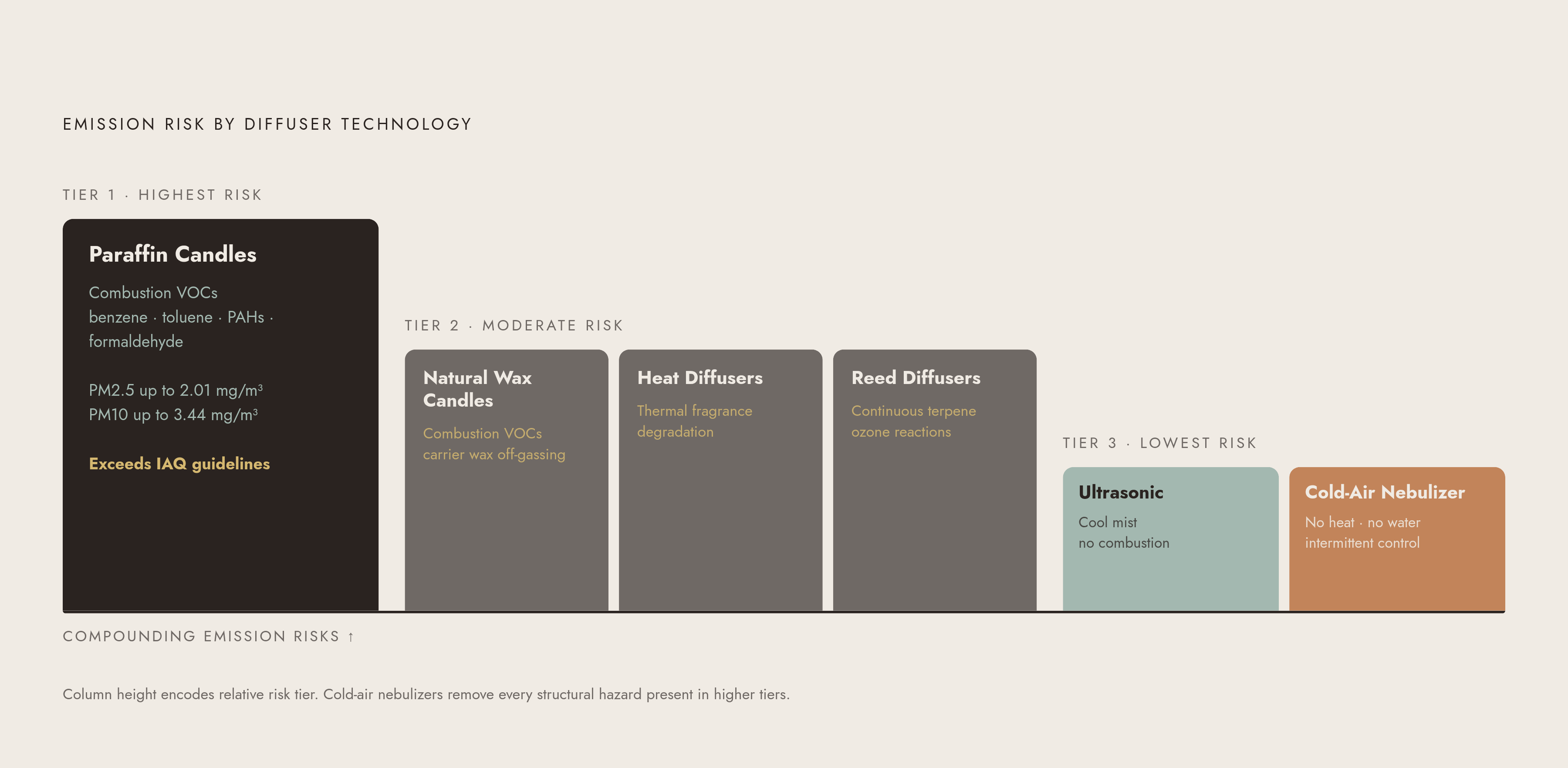
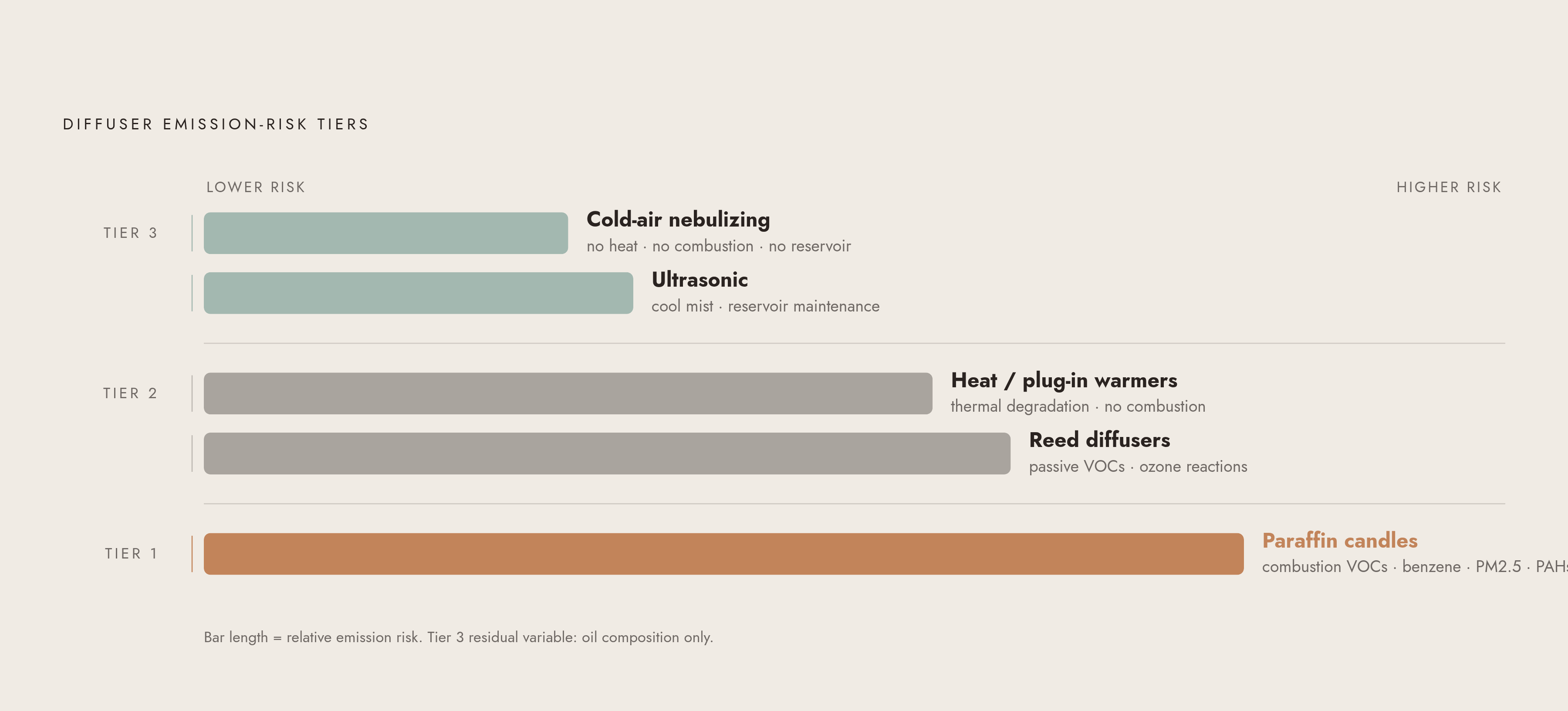
The comparative ranking is defensible and worth stating plainly.
Paraffin scented candles represent the highest emission risk profile: combustion VOCs including benzene and toluene, PAHs, formaldehyde, and significant particulate matter. Natural wax candles with clean fragrance in ventilated rooms reduce that risk but do not eliminate the combustion byproduct category.
Heat diffusers and plug-in warmers are a step down from candles on particulate matter and combustion chemistry, but the heating process introduces thermal degradation of fragrance molecules and potential off-gassing from carrier waxes. The thinner evidence base is itself a reason for caution rather than reassurance.
Reed diffusers remove combustion risk entirely and improve the particulate profile, but continuous passive emission and the secondary reaction potential of common terpene constituents make cumulative exposure the operative concern. Most commercial products do not meet a meaningful disclosure standard.
Ultrasonic diffusers offer lower primary VOC output than any combustion or heat-based format, and the cool mist mechanism does not alter oil chemistry. The reservoir maintenance requirement and humidity contribution introduce practical secondary concerns.
Cold-air nebulizing diffusers have the fewest compounding emission risks: no combustion byproducts, no thermal degradation, no water reservoir biology, and controllable intermittent operation. The residual variable is oil composition, which applies across every format.
The practical framework has three tiers. First, choose the delivery mechanism with the fewest structural emission risks, which points toward cold-air nebulization or, as a more accessible alternative, ultrasonic diffusion with a well-maintained device. Second, evaluate oil composition independently of device selection using the disclosure standard described above. Third, account for space and ventilation: interval scheduling and adequate air exchange are behavioral controls that every format benefits from.
Separating device risk, oil risk, and usage pattern risk into distinct variables rather than a single intuitive judgment is what makes the ranking legible.