Ventilation Requirements for Safe Indoor Diffuser Use
Sealed rooms and continuous diffusion create dangerous VOC buildup.
Start with what the device is actually doing. When a diffuser atomizes fragrance or essential oil, it seeds the surrounding air with volatile organic compounds, VOCs, which sounds alarming until you realize the category includes alpha-pinene (that pine forest smell), limonene (citrus peel), and linalool (lavender's floral note). These are not industrial adulterants slipped into your wellness routine. They are the chemistry of the fragrance itself, suspended in the air you are breathing.
The scale of that chemistry deserves a pause. Research has found that a single essential oil can emit between 20 and 140 distinct VOCs. One study across 24 oils identified 595 VOCs spanning 188 distinct compounds. A bottle on a shelf is, essentially, a small library of airborne chemistry waiting to be opened.
That raises an important question: if the compounds are naturally occurring, why does any of this matter? The answer is not in the compounds themselves but in what they can become. In the presence of ozone, which sits at background levels in most indoor environments, certain VOCs react to produce secondary pollutants including formaldehyde and ultrafine particles. The diffuser does not produce these directly. The room's chemistry does, given the right inputs and enough time.
Particle size sharpens the concern. Ultrasonic diffusers generate particles in the 10 to 200 nanometer range, small enough to bypass the body's upper-airway filtration and reach deep lung tissue.
But here is the data point that gets buried: one study measuring total VOC output from a diffuser in an actual room found combined levels peaking at just 0.6 parts per billion. The highest toluene reading recorded was 0.00025 ppm, well below Japan's regulatory threshold of 0.07 ppm. The chemistry is real. The risk, at normal use levels in a ventilated room, is a different matter.
The variables that actually move the needle are continuous diffusion, a sealed room, and high oil loading, all three together. Not the specific oil, not the brand of device. The conditions are the thing.
How a Closed Room Turns a Pleasant Scent Into an Air Quality Problem
Concentration is the key variable, and it behaves predictably once you understand the mechanism.
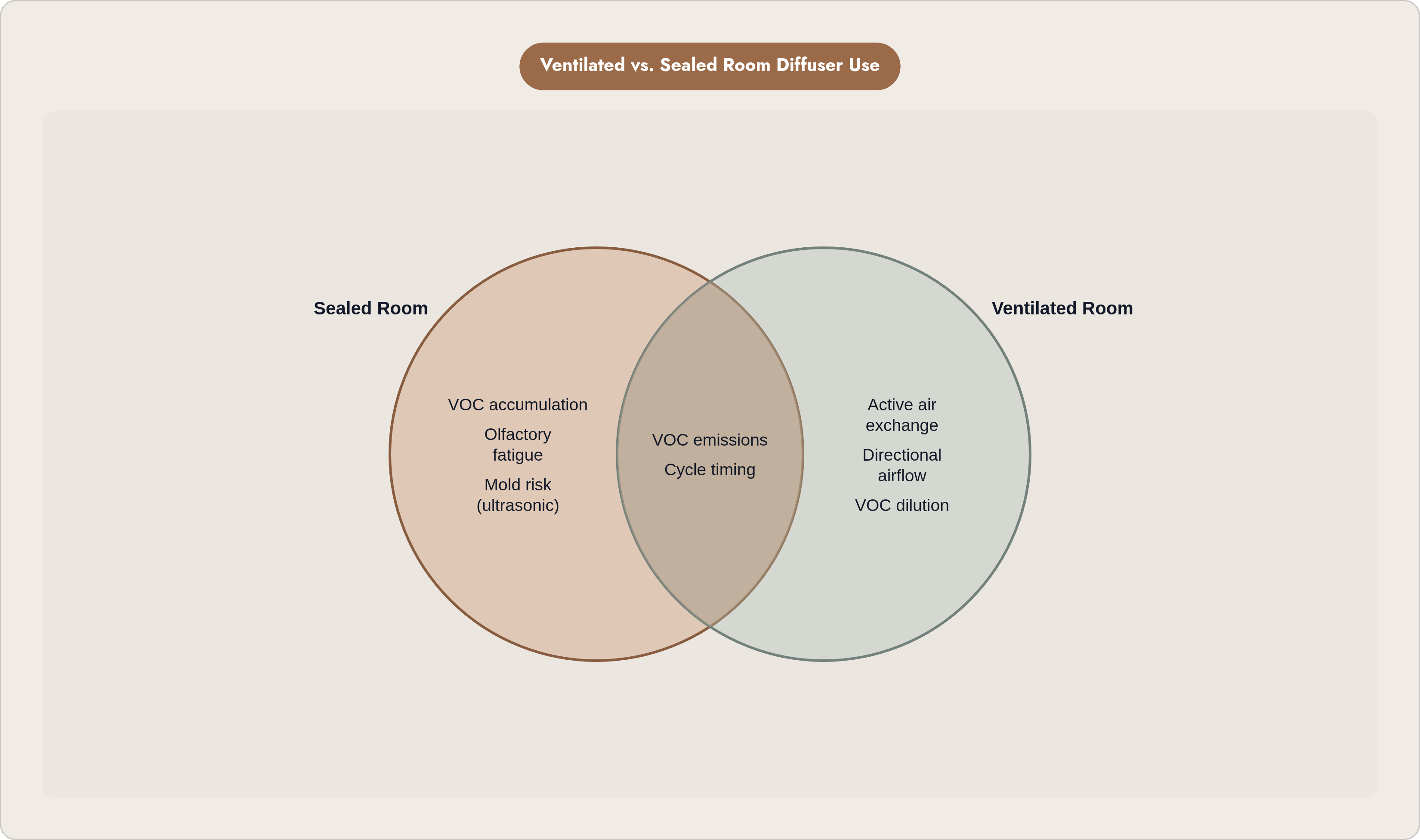
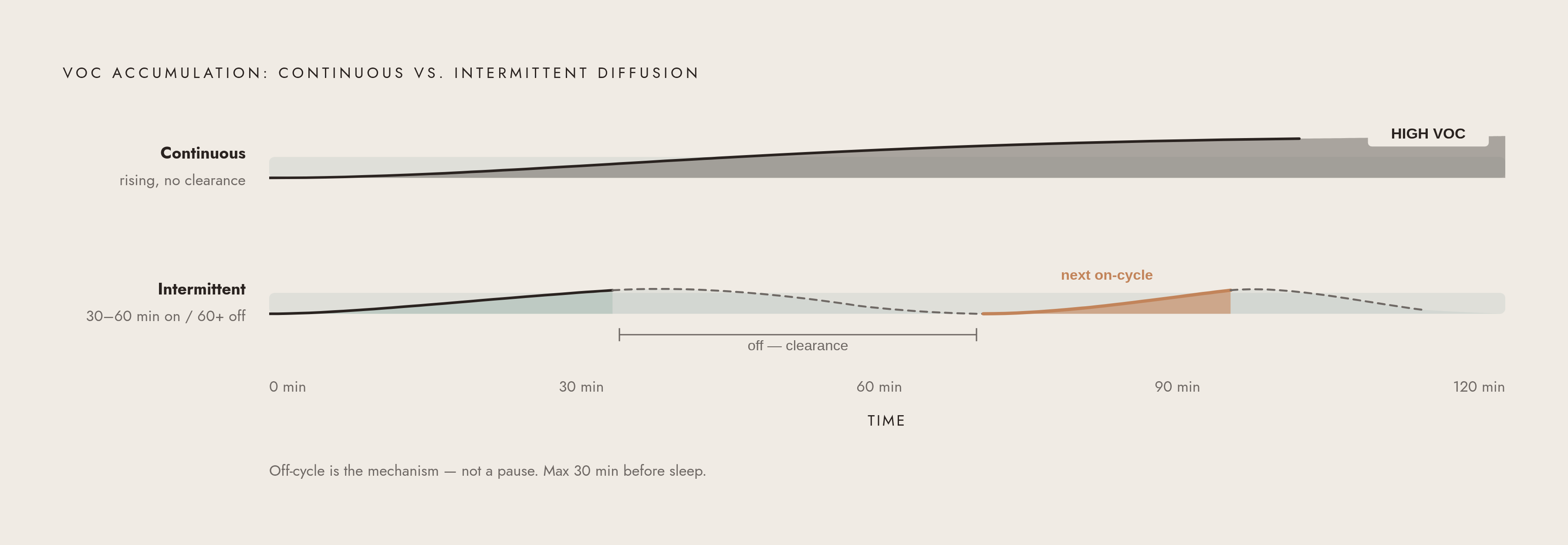
The same diffuser, the same oil, the same output: in a sealed room, it produces a meaningfully different outcome than in one with active air exchange. VOC levels climb continuously as long as the device runs, because there is no natural ceiling without fresh air replacing spent air. Smaller rooms reach uncomfortable concentrations faster; the particle output is identical, but the air volume absorbing it is not.
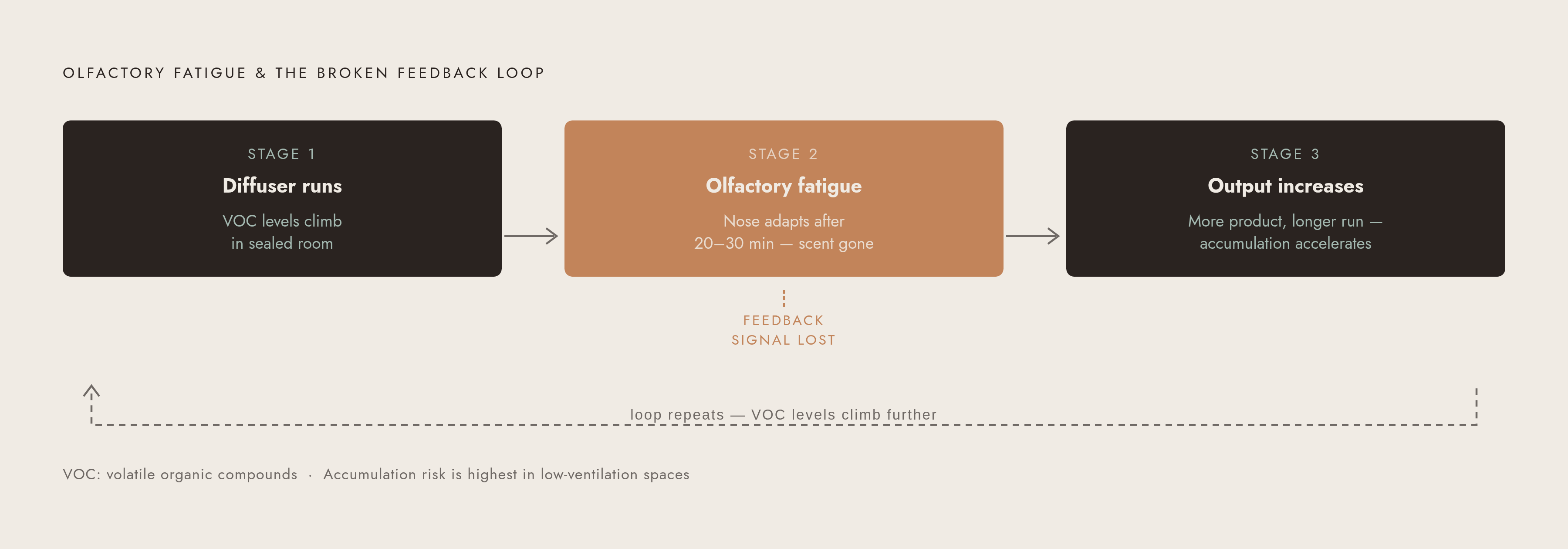
Why exactly does this become a practical problem rather than a theoretical one? Olfactory fatigue. As concentration climbs, the nose adapts and eventually stops registering the scent entirely. Most people read that as the diffuser underperforming. The natural response is to increase output or extend the run time, both of which accelerate accumulation. The nose has, quietly, removed itself from the feedback loop at the exact moment feedback matters most.
The scenario that moves from merely irritating to seriously concerning follows a recognizable pattern: continuous diffusion, sealed room, small square footage, high output, sensitive occupant, extended time in that space. Each factor multiplies the others. Remove any one of them and the risk profile changes substantially.
Symptoms that point toward poor air exchange rather than a bad oil include headache, eye and throat irritation, and mild dizziness. These are consistent with elevated VOC accumulation, not with any specific fragrance compound. Switching oils does not fix this. More air exchange does.
The Practical Ventilation Baseline Every Diffuser User Should Meet
The baseline principle is plain enough to remember: diffuse into moving air, not static air.
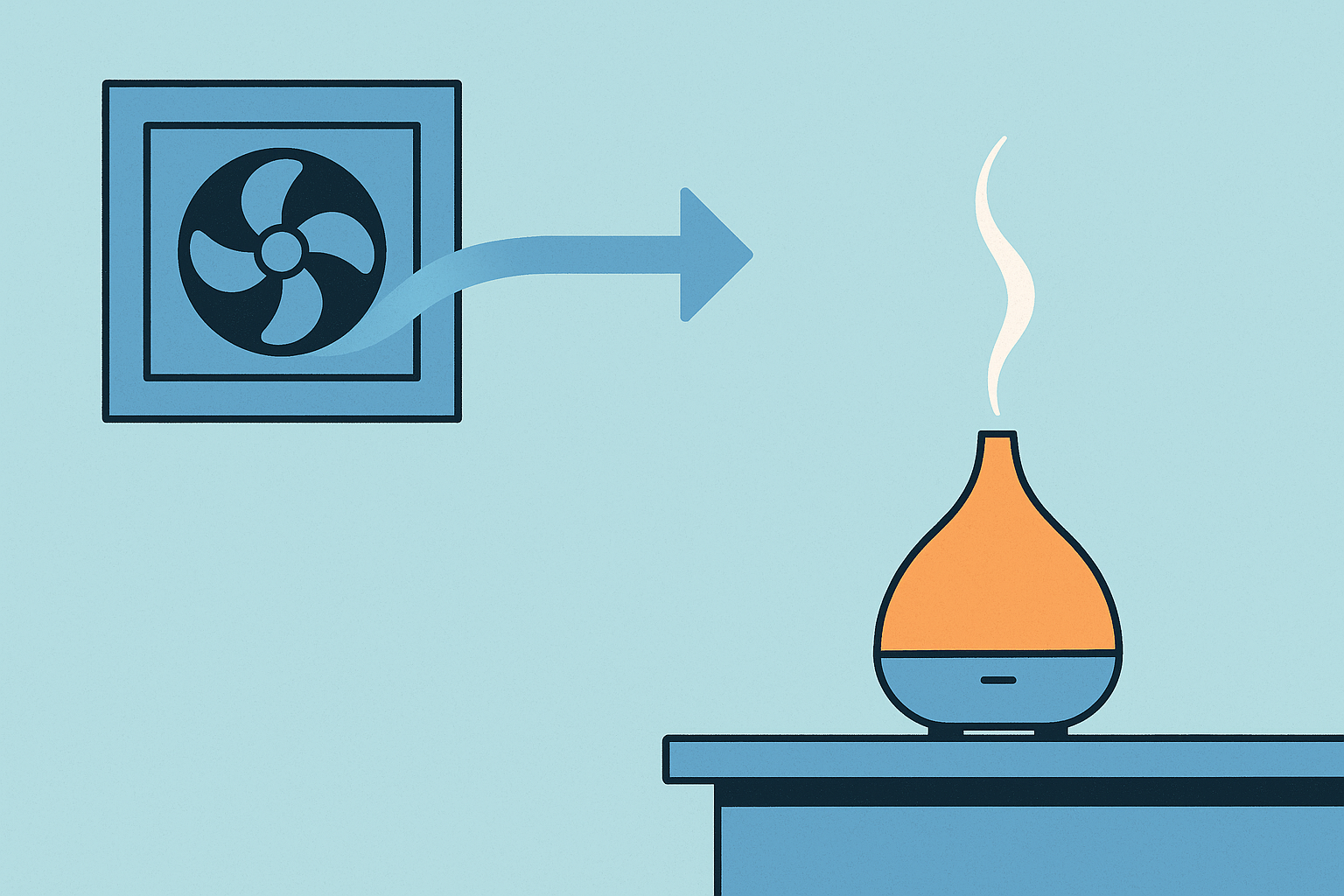
A cracked window creates passive air exchange that prevents compound buildup. Cross-ventilation, achieved when openings on opposite sides of the room are both active, is more effective than a single window because it creates directional flow rather than simply enlarging the sealed space by a few square feet. When windows are impractical, a fan positioned to push air toward an opening produces similar results. The goal is directional airflow, not recirculation within the same sealed volume.
Room size is a direct input. The same diffuser that performs without incident in a large open-plan living space carries meaningfully higher accumulation risk in a small bathroom or a closet repurposed as a home office. ASHRAE Standard 241 benchmarks clean indoor air at five or more air changes per hour, a useful reference point for anyone thinking about this rigorously. The EPA's 2024 updated ventilation guidance emphasizes layered indoor air quality strategies, particularly for homes with children, elderly residents, or people managing chronic respiratory conditions.
For most homes, a cracked window and a ceiling fan on low during a diffuser session comes reasonably close to meeting that standard in a normally sized room. Output settings, which most diffusers offer and most users set once and promptly forget, are part of this calculation too. Matching output to room size and ventilation capacity is the first adjustment worth making.
Timing Diffusion Cycles to Match What the Body and the Air Can Handle
Continuous diffusion is the single most common ventilation mistake, and it is easy to understand why it persists. The device is designed to run. Running it feels like using it correctly.
It is also worth considering what continuous diffusion eliminates: the body's recovery window and the air's clearing window, simultaneously. The pattern supported by VOC accumulation research is 30 to 60 minutes on, then at least 60 minutes off before the next cycle. The off-cycle is not a pause in the experience. It is the mechanism that makes the next on-cycle worth having.
Overnight diffusion deserves particular scrutiny. Continuous nighttime exposure is associated with dried mucous membranes and morning headaches. The better approach is 30 minutes before sleep, device off before getting into bed. More run time does not equal more benefit; it equals more accumulation against a respiratory system that cannot advocate for itself while unconscious.
Diffusers with programmable interval timers make intermittent cycling automatic, which matters because scheduling replaces willpower with a built-in rhythm.
Olfactory fatigue is worth revisiting here as a signal most users misread. When the scent becomes undetectable after 20 to 30 minutes, the nose has adapted. Increasing output in response adds directly to accumulation. The correct response is to let the off-cycle run and allow both the air and the olfactory system to reset.
Where Diffuser Type Affects How Much Ventilation Is Actually Needed
Not all diffusers create identical ventilation demands. Atomization method determines particle size, output concentration, and moisture load, and each of those changes the calculation.
Heat diffusers are the most complicated case. Applying heat to fragrance or essential oil alters the oil's chemistry during operation, producing byproducts not present in the original compound. Beyond chemistry, heat diffusers carry fire risk. Candles fall into this category, which is worth stating plainly given how often they escape scrutiny in these conversations.
Ultrasonic, water-based diffusers add humidity alongside VOCs. In an insufficiently ventilated space, that moisture creates a secondary air quality concern entirely separate from fragrance: mold growth, both inside the device and on nearby surfaces. Cleaning an ultrasonic diffuser regularly is not a hygiene nicety. It is a ventilation safety requirement. A device with standing water that goes uncleaned will disperse mold or bacteria alongside fragrance, which is an air quality problem of an entirely different character.
Cold-air nebulizing diffusers disperse fragrance without heat or water, preserving the oil's original chemical structure and avoiding moisture-related risks by design.
But here is the nuance worth insisting on: cold-air diffusers produce concentrated output. No heat and no water does not mean no VOCs. Ventilation rules still apply, and output should still be matched to room size. The practical ventilation advantage is that without a humidity load, you are solving a simpler problem, airborne fragrance compounds only, rather than airborne compounds plus a moisture problem.
Extra Ventilation Care for People Most Sensitive to Airborne Compounds
The research consensus for healthy adults using ventilated rooms in 30 to 60 minute cycles places diffuser exposure in a low-priority risk category. That consensus does not extend uniformly to every household, and this is the part of the conversation people skip.
People with asthma or COPD can experience bronchospasm, airway tightening, coughing, wheezing, shortly after a diffuser activates, even at low output settings. For these households, the conversation with a medical professional should happen before diffuser use starts, not after the first reaction.
Pets are an underappreciated variable. Cats and birds have respiratory systems considerably more sensitive than adult humans. A pet-safe approach means lower output, shorter cycles, and ensuring the animal can physically leave the room. The ventilation standard in a mixed household is set by the most vulnerable occupant, not the average one.
Infants and young children process airborne particles differently than adults. Smaller lung volumes relative to body weight, combined with still-developing respiratory systems, mean that concentration levels matter more for them, not less. Nurseries are not appropriate environments for continuous diffusion.
Pregnancy introduces specific compound contraindications that ventilation alone does not resolve. Reducing overall exposure through better air exchange helps, but it does not substitute for knowing what is actually in the oil.
What extra ventilation care looks like in practice: cycles closer to 20 to 30 minutes, a window and a fan rather than a window alone, lower output settings, and diffuser placement that keeps peak concentration away from where the sensitive person spends most of their time. Fragrance oils with fully disclosed ingredient lists become relevant here. Knowing what compounds are in the air is a prerequisite for making well-informed decisions about managing them.
Putting the Principles Together Into a Room-by-Room Diffuser Setup
Abstract principles land differently when mapped to actual spaces, so it is worth being specific.
Living Rooms and Open-Plan Spaces
Largest air volume, most natural exchange from foot traffic and adjoining rooms. Standard 30 to 60 minute cycles with a cracked window address most situations. Output can be moderate. This is the most forgiving environment in the home, ventilation-wise, and it earns that status.
Bedrooms
Bedrooms carry higher ventilation priority than their square footage suggests, because occupants are stationary and breathing deeply for extended periods. Diffuse before sleep; switch off before getting into bed. Lower output setting. A cracked window, even a narrow one, matters more here than in any other room. Overnight diffusion, regardless of how appealing the intent, is not the move.
Home Offices
Closed-door setups accumulate VOCs faster than open rooms. Intermittent scheduling, 30 minutes on and 60 off, is especially important here because the occupant is typically stationary for long stretches. A desk fan directed toward a window vent provides adequate exchange without any architectural intervention.
Small Rooms and Bathrooms
Highest concentration risk per square foot, least natural air exchange. Very short cycles, low output, and an exhaust fan running simultaneously are the standard here, not optional upgrades. These are the rooms where ventilation discipline pays off most visibly and most quickly.
Diffuser Placement Within the Room
Placement shapes distribution in ways most users never think about. Central placement with unobstructed airflow disperses fragrance more evenly and prevents localized concentration near vents, furniture, or occupied seating. Placing a diffuser in a corner or immediately adjacent to where someone sits concentrates exposure without any corresponding benefit.
The thread running through every room is the same: match output to volume, establish air exchange before starting, run cycles rather than continuous streams, and let the off-cycle do its work. None of this requires significant effort. It requires considerably less effort than managing the consequences of not bothering.