Do Water Diffusers Cause Mold on Walls
Humidity above 60 percent activates mold spores on your walls.
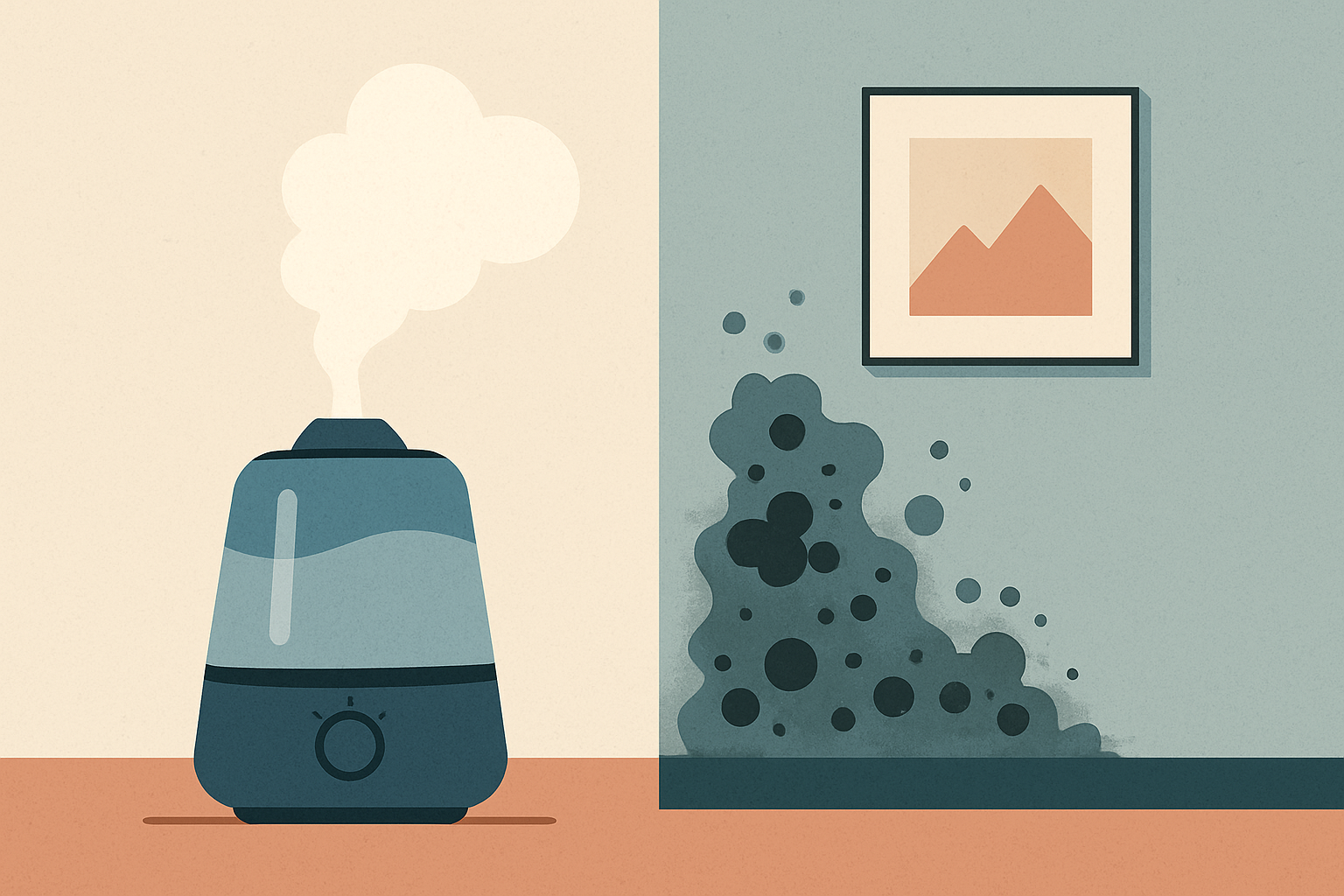
The number worth remembering is 60. Indoor relative humidity above 60 percent is where dormant mold spores shift into active colonization mode. Below that threshold, most species remain inert; above it, they begin converting available moisture into biomass on whatever porous surface is nearest: plasterboard, window frames, the back of a bookshelf flush against an exterior wall. The EPA recommends keeping indoor relative humidity between 30 and 60 percent to inhibit mold growth. That is not a conservative recommendation. It is the line.
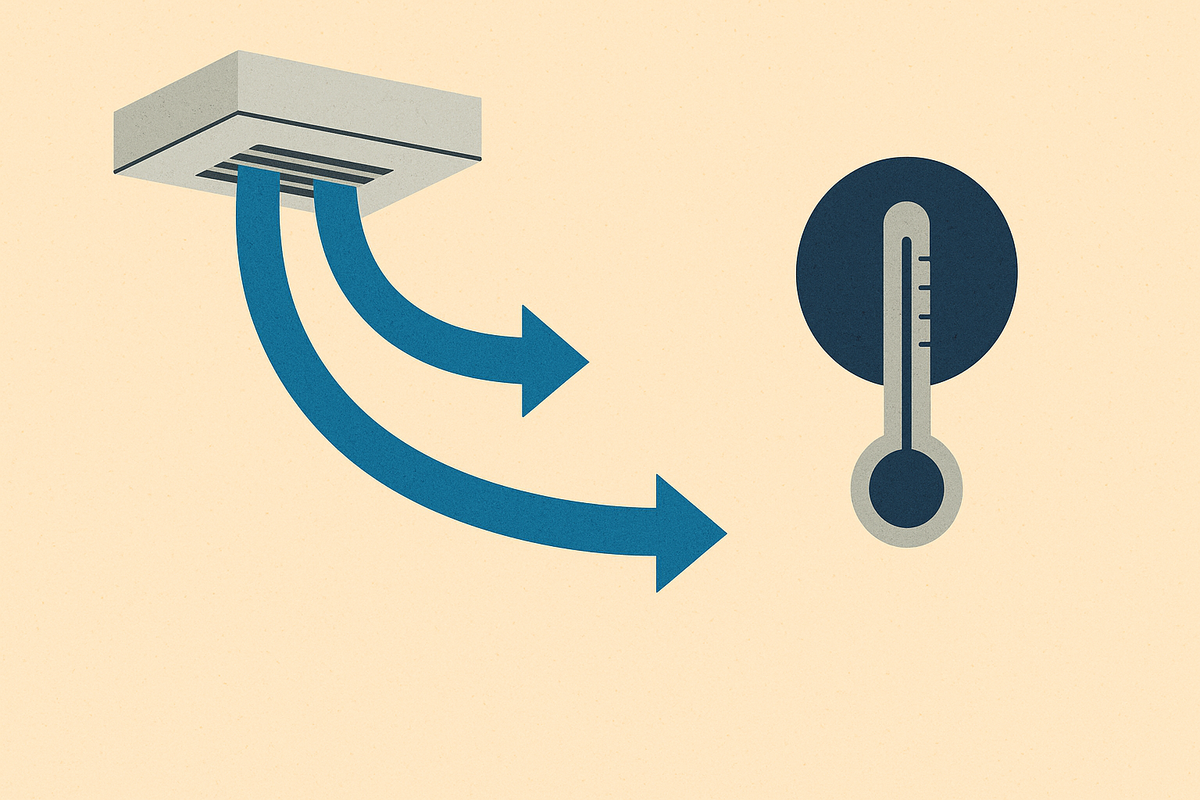
Temperature compounds this. Mold colonizes most aggressively between roughly 77°F and 86°F, a range that overlaps substantially with normal winter heating. The same season when people seal their windows, run their heat, and reach for the diffuser most often is also the season when interior surfaces are most hospitable to biological growth. Worth sitting with that for a moment.
A device running continuously in a small, poorly ventilated room can push humidity past 60 percent without producing any perceptible sign. No visible condensation on the glass. No dampness underfoot. No alert of any kind. The air simply becomes progressively more saturated while the diffuser hums along looking perfectly functional. Think of it as a slow tide: you never see the water rising, only the waterline it leaves behind.
Most households have no way to know this is happening. A hygrometer costs less than most fragrance oils and is almost universally absent from the rooms where diffusers run. Without one, every runtime and placement decision is made in complete informational darkness. That is a solvable problem.
How placement and runtime turn a safe device into a risky one
A diffuser placed in the corner of a room, against a wall, in a closed bedroom is doing three problematic things simultaneously. It is concentrating moisture output at the nearest surface. It is operating in a space with no cross-ventilation to dissipate that moisture. And if it runs overnight, it is doing so for six to eight consecutive hours.
The commonly cited guideline is to keep diffusers at least three feet from walls and soft furnishings. That distance reflects the space needed for mist particles to mix adequately with surrounding air before contacting a surface. Closer than that, moisture begins accumulating on whatever is in the way.
Carpeted floors and upholstered furniture make this worse in a way that is easy to underestimate. These materials absorb moisture and release it slowly, creating localized damp zones even when a hygrometer at the center of the room shows a reasonable reading. The carpet directly beneath the diffuser can be measurably wetter than the ambient air suggests.
The same device that creates problematic humidity conditions in a 150-square-foot bedroom with the door shut presents a negligible risk in an open-plan living area with adequate airflow. So the diffuser is not really the variable here. The environment is. A diffuser in a sealed room is like a sponge in a sealed jar — the moisture has nowhere to go but in.
Winter heating systems actively strip moisture from indoor air, which creates some headroom for diffuser use. But less than most people assume. Cold outdoor air carries almost no moisture indoors through ventilation, the room stays sealed, and a diffuser running continuously can still tip past the threshold over several hours even from a dry starting point. The headroom is real; it is just narrower than it feels.
The mold risk that never touches the walls — what grows inside the diffuser itself
The more immediate biological risk is not the walls at all. It is the water tank sitting on your nightstand.
Biofilm, a structured colony of microorganisms primarily composed of bacteria but often including mold, can establish on wet surfaces within 24 to 48 hours at room temperature. The typical home temperature range of 65°F to 75°F is hospitable to many common household microorganisms. From a microbial standpoint, the diffuser reservoir is a warm, still, nutrient-available habitat. Most manufacturers recommend cleaning every one to two weeks. Biofilm can be well-established before that window closes.
Over several days without cleaning, the diffuser aerosols not just water and essential oil but fragments of biofilm, bacterial cells, mold spore fragments, and microbial metabolic byproducts, all in a size range similar to the water droplets themselves. Those particles are inhalable. They can reach the lungs. The EPA has specifically identified cool-mist devices as a source of biological pollutants when maintenance is insufficient, and ASHRAE classifies biological aerosols as a primary indoor air quality concern.
Plastic reservoir surfaces compound the problem. Microscopic surface porosity gives biofilm anchor points that a standard wipe-down cannot reach. Even extended vinegar soaks only partially penetrate established colonies. The geometry of most reservoir designs, with ridges, seams, and ultrasonic disc housings, makes thorough manual cleaning difficult, not just inconvenient.
Infants, people with asthma, allergy sufferers, and immunocompromised individuals bear the highest exposure risk. These are also, not coincidentally, the groups most likely to be spending extended hours in the rooms where diffusers run. That overlap is worth taking seriously.
Where ultrasonic diffusers sit in the full risk hierarchy of diffuser types
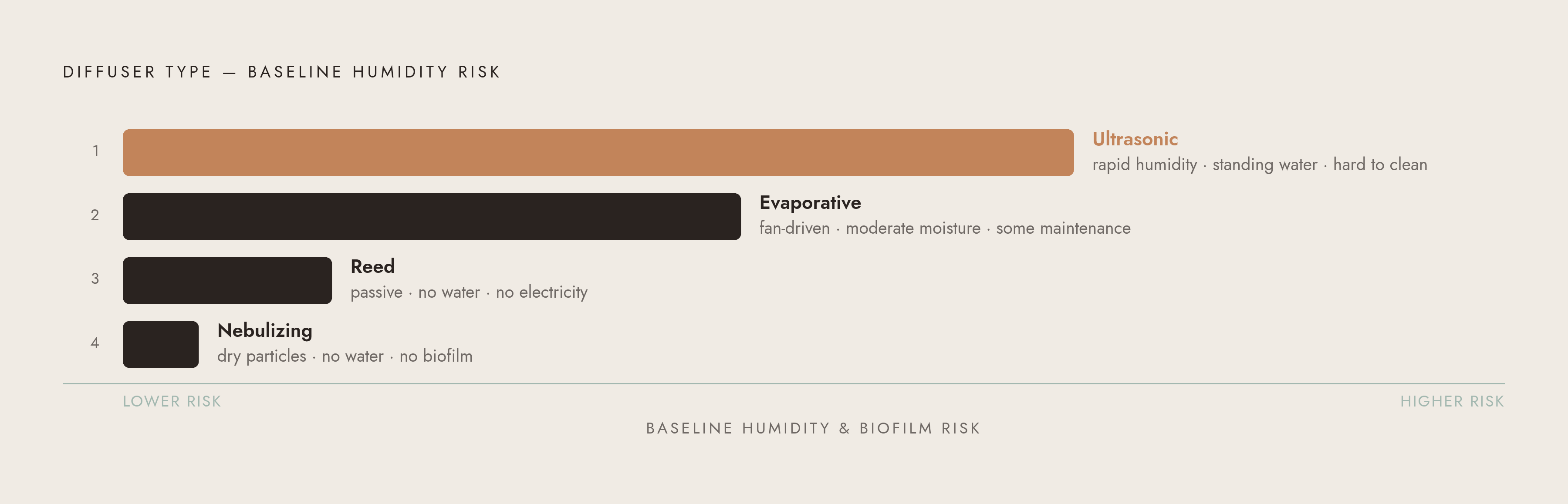
The type of diffuser is the single biggest variable in this conversation, and the conversation almost never starts there. It should.
Ultrasonic diffusers carry the highest risk profile among common diffuser types. Cool mist raises humidity rapidly; a standing water reservoir creates biofilm conditions; internal geometry resists thorough cleaning; oil is diluted with water, which weakens fragrance potency. These are not design flaws, exactly. They follow directly from the mechanics. But they do accumulate.
Evaporative diffusers sit in the middle. A fan disperses moisture more slowly than ultrasonic vibration, which reduces the humidity impact, though they still introduce water vapor and share some maintenance concerns.
Reed diffusers present effectively zero humidity or mold risk. No water, no electricity, passive evaporation only. The trade-off is limited coverage and no user control over intensity.
Nebulizing and cold-air diffusers use no water at all. No humidity impact, no biofilm risk, no moisture settling on surfaces. The technology atomizes pure oil using pressurized air rather than water as a carrier. Particles produced are dry at the point of dispersion and remain so.
A well-maintained ultrasonic diffuser presents a lower risk profile than a neglected one, and a neglected cold-air diffuser has its own problems. But the baseline risk, before any user behavior is considered, varies substantially across these categories. Asking whether diffusers cause mold without specifying which type is roughly like asking whether cars get good gas mileage.
How to use an ultrasonic diffuser without creating mold conditions
For users committed to ultrasonic diffusers, the lever with the most impact is runtime. A timer cycling the device on for thirty to sixty minutes and off for a comparable period prevents sustained humidity accumulation more effectively than any other single behavioral change. This one adjustment does most of the work.
Placement comes second. At least three feet from walls, off the floor if carpeted, away from soft furnishings. The goal is giving mist particles enough air to mix with before they contact a surface.
Water quality is underappreciated. Tap water introduces mineral deposits that provide additional anchor surfaces for biofilm. Distilled water reduces that problem measurably. Research comparing tap and distilled water in ultrasonic devices has found differences in particle output; distilled water generally produces cleaner results.
Daily maintenance matters more than periodic deep cleaning, though both are necessary. Empty the tank after each session, wipe all internal surfaces dry, refill with fresh water before the next use. That routine removes the standing-water condition that establishes biofilm. A monthly disinfection with diluted hydrogen peroxide or diluted bleach addresses what daily wiping cannot reach.
Certain essential oils, tea tree, eucalyptus, and clove among them, have documented antimicrobial properties and slow in-tank biofilm development. They are not a substitute for cleaning, and they are not a substitute for humidity management. Think of them as a supplementary measure at best.
A hygrometer belongs in any room where a diffuser runs regularly. Keep indoor humidity below 60 percent. Crack a window or run a ventilation fan during use. These steps reduce risk substantially. They do not eliminate the underlying mechanism: an ultrasonic diffuser, even a perfectly maintained one, still adds moisture to the air.
How cold-air diffusion removes the moisture problem from the equation
To understand why cold-air diffusion sidesteps this problem entirely, start with the mechanism. Pressurized filtered air atomizes pure fragrance oil into a dry mist. No water involved at any stage. No heat. No reservoir.
No water means no humidity added to the room. No standing water means no surface for biofilm to establish. The internal contamination pathway described in the previous section simply does not apply. Neither does the condensation pathway connecting diffuser output to wall moisture.
Dry, nano-scale oil particles remain suspended in air longer than water-based mist and do not settle onto walls, fabrics, or electronics. For rooms with hardwood floors, art, or moisture-sensitive instruments, that is a practical advantage that compounds the air quality benefit. Not a trivial detail.
When oil is never diluted with water and never heated, its scent composition stays intact from first use to last. What the formulation contains is what reaches the room. That matters if the oil's chemistry, rather than its carrier medium, is what you are actually diffusing for. The Alliance of International Aromatherapists has specifically endorsed cold-air diffusion as the method that best preserves the complete chemical profile of essential oils, a scientific preference, not an aesthetic one.
Cold-air nebulizing technology is also compatible with HVAC systems, which enables consistent multi-room or whole-home scenting from a single unit. For households where humidity management, internal hygiene, or fragrance consistency are priorities, this product category is worth evaluating alongside ultrasonic options.
What to look for in fragrance oil to keep the whole system clean
The diffuser choice matters. The oil choice matters just as much, and it receives considerably less scrutiny.
Under current U.S. labeling law, manufacturers can list a substantial number of different chemicals under the single word "fragrance" on a product label. The consumer sees one ingredient. The formulation may contain dozens. Peer-reviewed research by Anne Steinemann, published in Environmental Impact Assessment Review, found that air fresheners emit over 100 different chemical compounds, with roughly one-fourth of the VOCs identified classified as potentially toxic or hazardous under federal standards. Phthalates appeared as undisclosed ingredients even in products labeled "all-natural." That is a peer-reviewed result, not a talking point, and it is a reasonable basis for scrutiny of unlabeled fragrance products.
What to look for: transparent ingredient disclosure, no phthalates, no added VOC carriers, and IFRA compliance. The International Fragrance Association's compliance framework represents a widely applied safety standard in the industry, benchmarked across people, pets, children, fabrics, and artwork. IFRA compliance is an imperfect signal, but it is a useful minimum.
For cold-air diffusers specifically, oil formulation matters for functional reasons as well as safety ones. Some oils are built around non-toxic, phthalate-free formulations designed for use with waterless diffusers. Oils containing water, heavy carrier additives, or synthetic polymers can damage the atomizer or produce unintended aerosol byproducts. Pure, appropriately formulated oil is not just a health consideration; it is a hardware consideration.
For households with animals, formulation scrutiny becomes more pressing still. Cats, in particular, lack certain hepatic enzymes necessary to metabolize compounds common in essential oils, including phenols found in tea tree, clove, and oregano. The aerosolized exposure route compounds the risk because diffused particles reach animals continuously, not just through direct application. That detail does not always make the label.