Home Diffuser Types Compared
Ultrasonic dominates the market, but cold-air diffusion preserves fragrance quality better.

Ultrasonic diffusers reportedly held over 70% of U.S. market share as recently as 2025. Dominance in a consumer category gets mistaken for a merit judgment constantly, and this case is worth slowing down for.
They became the default because they are cheap, widely stocked, and produce visible mist. That last part is underrated as a sales driver. You can see it working, which in a category selling invisible molecules is a genuine distribution advantage. Not a performance advantage — like mistaking a fog machine for a window.
The mechanism is simple: high-frequency vibrations agitate a water-and-oil reservoir, producing fine mist that carries scent into the air. It works. The limitations, though, are structural.
Water dilutes the oil before it ever reaches the air. This hits top notes hardest, since those lighter, more volatile aromatic compounds are the first impression of any fragrance and the most vulnerable to concentration loss. What survives into the room is a softer, flatter version of the oil. Coverage is also constrained by design; an ultrasonic diffuser handles a single room reasonably well and gets overwhelmed by an open floor plan.
Then there is the water itself. Standing water in a reservoir is a hospitable environment for bacteria and biofilm, and biofilm does not stay put. It exits with the mist. Oil residue accumulates on the ultrasonic plate over time, gradually reducing vibration efficiency in ways subtle enough that most users don't notice until performance has dropped significantly. In small, poorly ventilated spaces, the added moisture output becomes its own secondary problem.
None of this disqualifies the format. For a bedroom, a study, or a household where the ambient mist is part of the appeal, ultrasonic is well-matched to the expectation. But there is a ceiling. The real question is whether that ceiling is too low for the room you are actually trying to scent.
What cold-air diffusion actually does to fragrance molecules and why it produces a different result
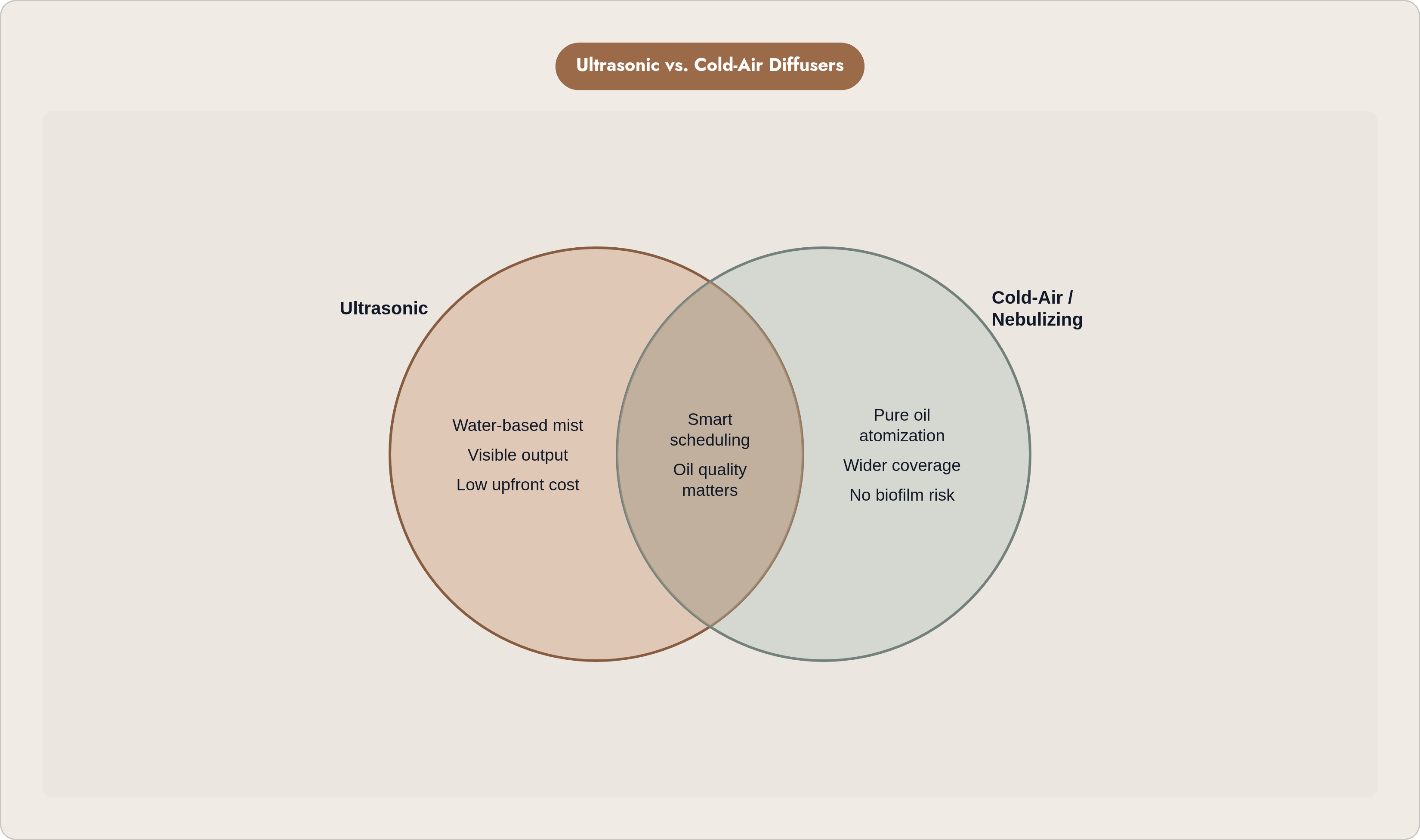
Cold-air, or nebulizing, diffusers operate on a different engineering premise entirely. Pressurized air and an atomizer break pure fragrance oil into ultra-fine dry particles. No water, no heat, nothing contacts the oil except air.
Why does that matter? Consider what a well-composed fragrance actually is: a layered arrangement of volatile aromatic compounds at different evaporation rates, which is precisely what creates the progression from top note to base note over time. Heat accelerates evaporation unevenly, burning off lighter molecules first and flattening the composition — the olfactory equivalent of skipping straight to the last chapter. Water dilutes the concentration. Cold-air atomization bypasses both interventions, delivering the oil to the air in something close to its original chemical state.
Particle size has spatial consequences, too. Dry atomized particles are light enough to remain suspended longer and travel farther than heavier water-based mist droplets, which fall relatively quickly. The practical result is more even distribution across a space, rather than a concentrated plume near the device. Commercial scenting installations in hotel lobbies and retail environments have used cold-air technology for this reason, though performance in those settings depends heavily on the specific installation and space.
The trade-offs are real. Cold-air diffusers cost more upfront. Because they use pure oil with no water dilution, oil consumption is meaningful. Smart scheduling, which most capable devices offer, manages that cost practically. Some models produce audible sound during the atomization cycle, enough variation by device to warrant checking before purchase. One point that clean-fragrance marketing tends to underplay: dry atomization means no residue settles on nearby surfaces, which is not a trivial consideration in rooms with furniture, electronics, or artwork close to the diffuser.
The number on the box and the room you actually live in
Every diffuser ships with a coverage claim. Almost none of those numbers reflect occupied conditions.
A commonly cited practitioner adjustment, referenced by Scentia, is roughly half the stated maximum in a furnished, occupied room with walls, doorways, and variable airflow. A device rated for 2,000 square feet will perform across significantly fewer square feet in actual use. That gap exists because coverage claims are calculated against controlled, empty test environments that bear little resemblance to a furnished home.
Several variables reliably shrink real-world coverage. Open floor plans with high ceilings disperse scent upward rather than outward; warm, fragrance-carrying air rises. Heavy furniture and soft surfaces absorb fragrance molecules before they fully circulate. HVAC airflow either works with the diffuser or against it, depending on placement. Frequent door-opening cycles interrupt scent accumulation and force the device to rebuild concentration from a lower baseline each time.
In practical terms: reed diffusers and small ultrasonic units are appropriate for bathrooms, bedrooms, and small studies. Mid-range cold-air diffusers suit living rooms, open kitchens, and home offices where consistent scent quality across the full space is the actual goal. Large cold-air units or HVAC-integrated systems can address whole-floor coverage up to around 3,000 square feet, per Scentia.
The most common purchasing mistake is choosing a device by aesthetic or price point, then running it at maximum intensity to compensate for undersizing. That produces an overpowering scent environment, not a balanced one. The mismatch between device and space is the actual problem, and it is a predictable one.
Reed diffusers, heat diffusers, and HVAC systems: where each one fits and where it doesn't
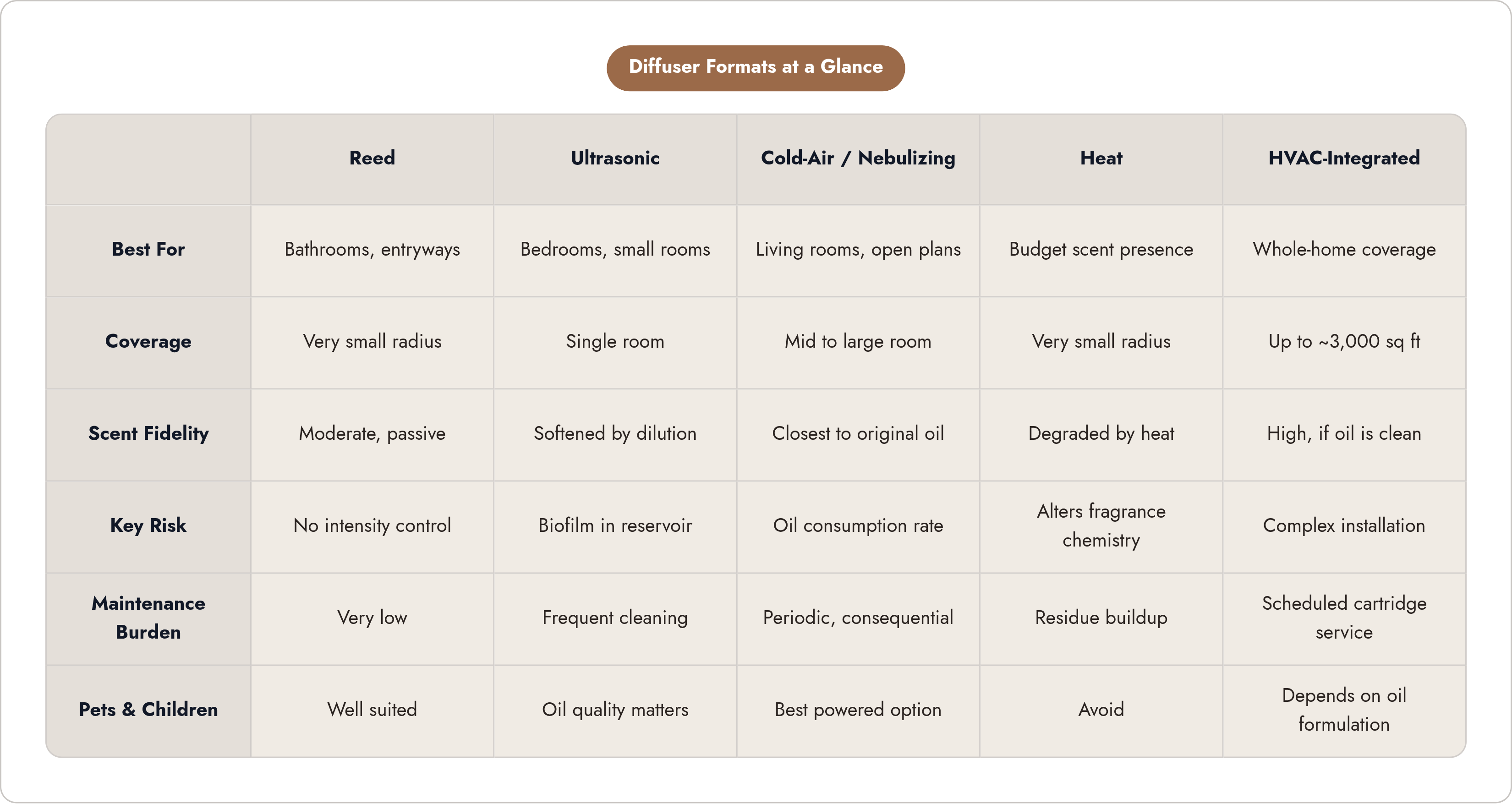
Reed diffusers operate on passive capillary action: fragrance travels up wooden reeds and evaporates at the tip. No electricity, no flame, no maintenance cycle worth mentioning. For bathrooms, entryways, and guest rooms where the goal is a subtle, consistent background scent that simply exists without requiring attention, the format is well-matched. It cannot be adjusted for intensity, cannot be timed, and its coverage radius is inherently small. Oil consumption is continuous and passive; there is no off switch. The safety profile, though, is strong across households with children and pets, since there is no heat source and no electrical component to manage.
Heat diffusers, including electric warmers, wax melts, and lamp rings, represent the category's lowest cost of entry. The core concern is chemical rather than mechanical. Heat can alter fragrance compounds during evaporation, potentially degrading the scent profile before it reaches the air. For anyone selecting essential oils for their aromatic properties specifically, heat will reduce those properties before the oil has a chance to do anything useful. If scent quality is the actual priority rather than mere scent presence, this is the format to move away from.
HVAC-integrated systems apply cold-air technology directly to existing ductwork, distributing dry fragrance mist across multiple rooms or an entire floor simultaneously. Coverage can reach around 3,000 square feet with adjustable concentration controls, per Scentia. The investment is higher, and installation requires professional consideration of duct layout and existing airflow patterns. For larger homes where whole-home consistency is a genuine requirement, the format justifies its cost. For most households, it is the right answer to a question they are not actually asking, and recognizing that before purchase saves real money.
"Clean" and "non-toxic" are doing a lot of work on that label
The gap between label language and ingredient transparency in home fragrance is wide enough to be genuinely frustrating. "Natural fragrance," "parfum," "aroma," and "fragrance oil" can all legally describe synthetic compound blends unless a product is explicitly labeled 100% essential oil. That ambiguity has direct implications for air quality, and those implications differ substantially by format.
Heat diffusers and plug-in air fresheners raise the most concern. Heat combined with synthetic fragrance compounds can produce volatile organic compounds and secondary reaction products. Medical toxicologist Ryan Marino, MD, has noted that certain plug-in air freshener ingredients can be toxic or form toxic byproducts in the home environment. The concern is format-specific: the same oil that poses minimal risk in a cold-air diffuser can generate different chemistry when heated.
Ultrasonic diffusers with synthetic oils release whatever is in that oil as mist into the breathing space. The format itself is chemically neutral; the oil quality is not. Cold-air diffusers operating with pure, clean oils produce no combustion, no heat alteration, and no water-based contamination pathway, which gives that combination a stronger safety profile among powered formats.
That said, here is a nuance the clean-fragrance space tends to quietly omit: even natural terpenes in fragrance can react with ambient ozone to generate secondary fine particles indoors, a reaction mechanism documented in atmospheric chemistry research for common terpenes. That is not a reason to avoid diffusers. It is a reason to ventilate routinely and to favor intermittent, lower-intensity diffusion over continuous high output, regardless of format or oil purity.
For households with pets, the relevant variable is not the diffuser format itself but the oil formulation and the concentration in the air. Cats and dogs have significantly more sensitive olfactory systems than humans; oils tolerated easily by people can be irritating at high concentrations. The answer is clean, verified-safe formulations and precise intensity controls, not avoiding fragrance diffusion entirely.
The regulatory context sharpens this further. EU REACH regulation is tightening VOC disclosure requirements for fragrance products. U.S. consumers currently lack an equivalent mandate. The practical signal: brands meeting or exceeding those standards before they are required to are telling you something meaningful about their formulations. Voluntary transparency is not nothing.
Maintenance is the variable nobody thinks about at the register
Maintenance determines whether a diffuser still performs at purchase-level quality six months later. It is also the variable most buyers evaluate least carefully, because it is hard to imagine at the point of purchase and easy to underestimate once the device is in use.
Ultrasonic diffusers require emptying the water reservoir after each use and periodic deep cleaning. Biofilm that develops on reservoir walls and the ultrasonic plate does not stay contained; it travels out with the mist. Oil residue accumulates on the plate over time, reducing vibration efficiency gradually enough that many users don't notice until performance has dropped significantly, at which point the cleaning required is more involved than it would have been at any earlier interval.
Cold-air and nebulizing diffusers carry no water reservoir and therefore no biofilm risk. The atomizer and oil chamber require periodic cleaning with isopropyl alcohol to prevent oil buildup that eventually clogs the nozzle. The intervals are less frequent than ultrasonic maintenance, but the consequence of deferring is more acute: a clogged nozzle degrades atomization meaningfully and, left long enough, causes nozzle failure.
Reed diffusers carry the lowest maintenance burden in the category. Flip the reeds every few days to refresh scent output, replace them when they become saturated and discolored. No solvents, no reservoir management, no electrical components.
Heat diffusers accumulate hardened oil residue on warming surfaces. The cleaning is straightforward, but residue left long enough will contaminate the scent of fresh oil, producing a burnt or muddied output that no amount of premium oil will correct.
HVAC-integrated systems require oil cartridge or reservoir replacement on a schedule, with duct-level service tied to the existing HVAC maintenance cycle. Whole-home convenience comes with whole-home service coordination, and that is worth factoring into the cost calculation from the beginning rather than discovering it at the first cartridge replacement.
Smart scheduling, available on better cold-air devices and some ultrasonic models, reduces total oil use and extends the interval between cleaning cycles — a practical efficiency with real implications for both operating cost and maintenance frequency, and one of the better arguments for spending more upfront on a capable device.
The right diffuser isn't the best diffuser. It's the right format for the actual room.
The decision is not "best diffuser." It is best format for a specific combination of room size, household composition, scent goal, and honest maintenance tolerance.
Small room, set-and-forget, no electricity preferred: reed diffuser. Bedroom or small living space, constrained budget, mist aesthetic valued: ultrasonic with a verified clean essential oil. Living room, open-plan kitchen, or home office where consistent scent quality across the full space matters: cold-air diffuser, sized to the actual square footage rather than the label maximum. Whole-home coverage with an existing HVAC system in good condition and a budget that accommodates the investment: HVAC-integrated cold-air system. Any household with pets or young children: cold-air or reed format with clean, non-toxic oils; heat formats and synthetic plug-ins are the formats to move away from.
Placement compounds the format choice. Central to the room, at or near nose height, away from supply vents that would immediately dilute the scent before it disperses: that is the baseline. Cold-air diffusers benefit from placement near, but not directly under, an HVAC vent, where existing airflow assists distribution without overwhelming it.
The intensity question applies across all formats. More output is not the goal; a balanced, consistent atmosphere is. Oversaturation is the most common mistake across every format, and it is far easier to avoid on a device with adjustable, programmable intensity than on one with a single output setting.
The formats are different enough that the wrong choice is a genuine mismatch between engineering and expectation. Getting it right requires knowing what each format actually does, what it costs to maintain, and whether that aligns with the specific space and household it is meant to serve.