Best Waterless Aroma Diffusers
Premium cold-air diffusers preserve oil integrity without heat or water dilution.

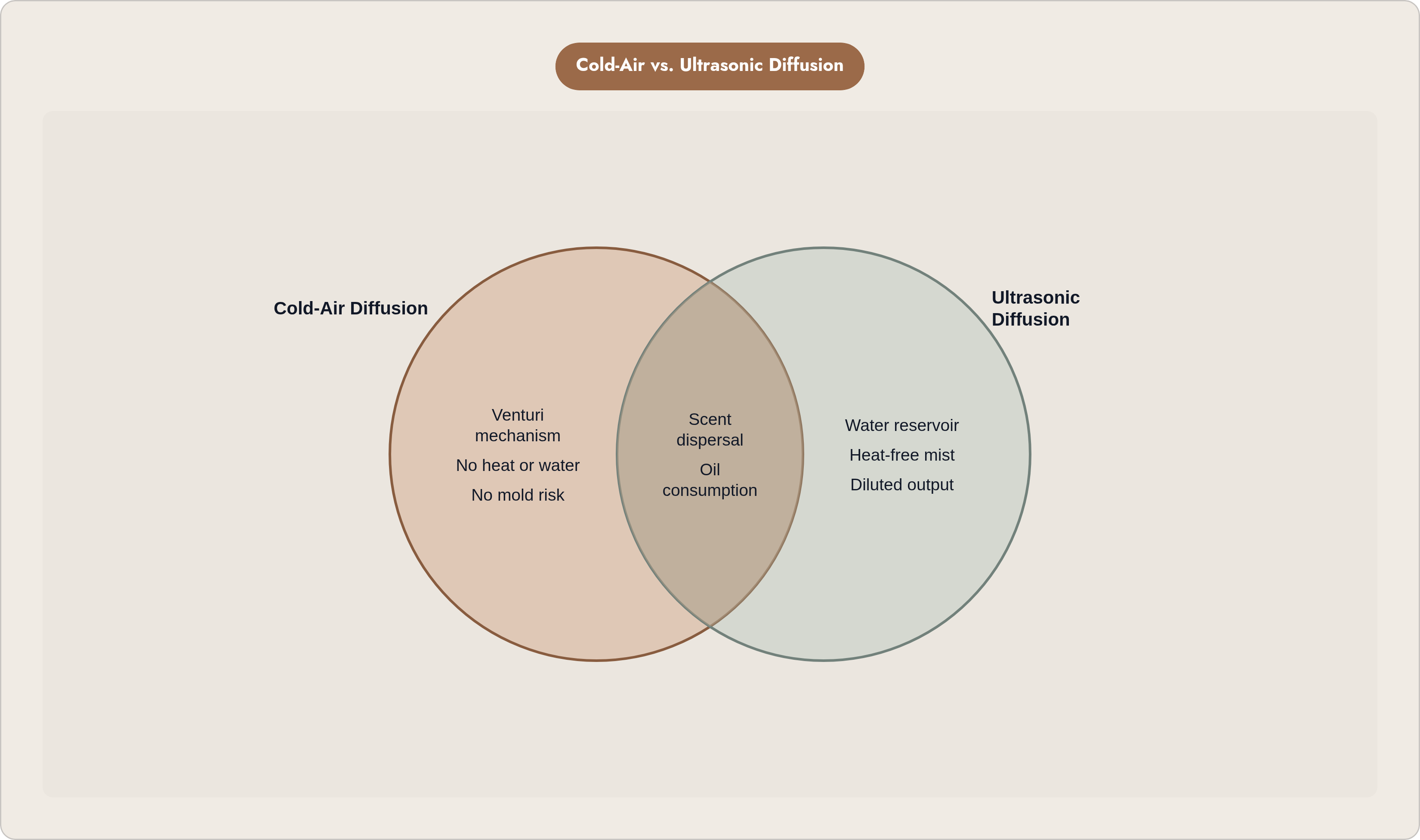
Start with the Venturi effect, because everything else follows from it. A pump compresses ambient air and forces it through a narrow nozzle at high velocity, creating a pressure drop that draws oil up from the reservoir. No heat, no water. The output is a nano dry mist: ultra-fine particles that stay suspended in the air column longer than what candles or ultrasonic devices produce, carried by natural air currents rather than sinking to the floor.
Why does heat matter? Terpenes, esters, and phenols, the compounds responsible for top, middle, and base notes, are susceptible to thermal degradation. Heat a complex oil and you change its chemical composition before it reaches your nose. Cold-air diffusion transmits the oil intact.
Why does water matter? Ultrasonic diffusers blend oil with water, diluting aromatic concentration proportionally. Less scent strength, less functional benefit, and a wet reservoir that invites mold. Cold-air systems sidestep all three problems at the design level.
That raises an obvious question: if the mechanism is clearly superior, why did early cold-air diffusers carry a poor reputation? Two reasons, both legitimate: loud pump noise and uncontrolled, overwhelming output. Current premium models have largely resolved both through better pump engineering and precision intensity control. Budget units are a different story, which is why the remaining criteria matter more than most buyers realize.
Scent purity starts with what's inside the oil, not just how it's diffused
Cold-air diffusion is faithful to a fault. It disperses whatever is in the bottle with precision and without alteration — the way a high-end speaker system does not improve a bad recording, it makes the flaws audible.
What does "clean" actually mean in fragrance? Three things evaluated together: the aromatic compound itself, whether 100% essential oil or natural fragrance or synthetic; the carrier substrate, plant-based oil versus synthetic resin versus petroleum derivative; and the dispersal method. The labeling environment makes this harder than it should be. "Natural fragrance," "aroma," "parfum," and "fragrance oil" appear routinely on packaging that contains synthetic compounds. Unless a label explicitly states "100% essential oil," synthetics are almost certainly present. The Environmental Working Group has documented how conventional air fresheners have historically concealed undisclosed synthetic chemicals behind a proprietary fragrance exemption.
It is also worth considering something the fragrance industry does not always volunteer: even naturally occurring terpenes react with indoor ozone to form secondary nanoparticle pollution, a finding documented in indoor air quality research published in journals such as Atmospheric Environment. This does not indict cold-air diffusion, which is far safer than combustion. It does mean formulation transparency matters regardless of how clean the delivery mechanism is. Phthalates and toluene, common in lower-quality formulations, carry health concerns documented by the National Toxicology Program. The delivery method cannot redeem a compromised formula.
What to look for: IFRA compliance, pet-safe and child-safe claims backed by actual formulation evidence, vegan and cruelty-free certification, and EPA Safer Choice standards where available. Aura House states that its fragrance oils are IFRA compliant and formulated without certain harmful ingredients, with explicit baby-safe and pet-safe positioning; cross-referencing those claims against published ingredient lists and certification documentation is the correct next step. Third-party accountability is a meaningful differentiator in a category where labeling opacity remains the norm.
Room coverage is the specification buyers most often get wrong
Cold-air diffusers span an enormous performance range. Depending on the unit, a single device covers a boutique bedroom or a commercial lobby — the difference between a puddle and an ocean. Professional-grade units run anywhere from 500 to several thousand square feet. Buying without cross-referencing coverage rating against actual room volume is the most common and most correctable mistake in this category.
Sizing correctly requires three inputs: floor area, ceiling height, and adjacency. An open-plan kitchen, dining room, and living room connected without doors is not three rooms for diffusion purposes; it is one large volume. A diffuser rated exactly to that square footage will operate at the edge of its capability. Sizing slightly above gives headroom for furniture absorption, variable airflow, and open doors.
Nano-mist particles follow air currents through open-plan spaces without requiring a second unit. In rooms with closed doors or poor circulation, that behavior becomes a constraint. A second unit or HVAC integration is the correct solution, not a stronger diffuser in the same location.
Some reference points from the current product landscape: the Aromadd 2025 Upgraded extends to 3,500 square feet with a 600ml reservoir capable of running up to 120 days without refilling. The Aromadd 2025 Upgraded extends to 3,500 square feet with a 600ml reservoir capable of running up to 120 days without refilling. At the higher end, a 5,000 square foot Wi-Fi waterless diffuser with a 1,000ml capacity and HVAC integration targets whole-home or light commercial deployment. The AromaPlan HVAC Diffuser covers up to 2,000 square feet with 10 intensity levels and Bluetooth connectivity. Aroma360's range spans 600 to over 6,000 square feet depending on the model. Confirm these figures against current product listings; manufacturer specifications update more frequently than most published reviews do.
Intensity control and scheduling determine whether the scent serves the room or overwhelms it
One of the more persistent misconceptions in this category is that more output signals a better diffuser. It does not. It signals a more expensive oil bill and a room that guests are quietly trying to escape. Overwhelming scent is a malfunction, not a feature.
Granular control separates devices that serve a room from those that dominate it. The difference between three intensity settings and ten discrete levels is not academic; it is the difference between an appropriate bedroom presence and a scent wall. Work/rest cycles, programmable intervals where the diffuser runs for a set period and then pauses, prevent olfactory fatigue while reducing oil consumption simultaneously. Automatic shutoff when the reservoir empties protects the pump and eliminates manual monitoring.
Smart scheduling raises the value of control considerably. App-connected diffusers allow different intensities and run schedules by room, time of day, or day of the week. A morning focus blend in a home office, a wind-down oil in the bedroom at 9 p.m., different parameters for weekdays and weekends: these are not luxury features. They are what make a diffuser genuinely useful rather than merely ambient.
The Moodo, launched in May 2025, blends up to four scents simultaneously with AI-driven adjustments based on time, weather, or mood, and integrates with Alexa and Google Home. The 5,000 square foot Wi-Fi diffuser noted above offers app-controlled schedules, mist intensity, and work/rest cycles via Bluetooth or Wi-Fi. For buyers who prefer simplicity, a manual intensity dial and a mechanical timer remain entirely valid. But the minimum acceptable threshold is variable intensity. A diffuser that offers only on/off is a room spray with a plug.
Noise, safety, and the real running costs most buyers don't calculate before purchasing
Cold-air diffusers are not silent, and that is worth knowing before placing one on a nightstand. Operating noise typically falls between approximately 30 and 45 decibels: a soft whisper at the quieter end, a refrigerator hum at the louder end. Some plug-in models operate around 35 dB; portable models run closer to 32 dB. Noise is the most underrated specification in this category for bedroom placement. A unit at 45 dB registers in a quiet room at night. Early-generation cold-air diffusers had legitimate grinding-noise problems; premium current models have addressed this, but budget units have not universally followed.
On safety, cold-air diffusion removes the three primary household fragrance hazards in a single design decision. No open flame eliminates fire risk. No heat element removes burn risk for children and pets. No water reservoir prevents mold growth and mineral residue. Some brands, including Aroma360, carry explicit pet-safe and child-safe claims tied to both formula and diffusion method; the depth of the underlying documentation varies by brand, so verifying formulation evidence directly is worthwhile.
Running costs deserve more scrutiny than they typically receive. The hardware purchase price is often the smallest number in a 24-month ownership equation. Proprietary cartridge systems price refills between roughly $40 and $50 per cartridge, which at regular use translates to approximately $540 per year in oil costs. Open-market compatible oils run around $19.99 per bottle, which under the same usage assumptions comes to roughly $240 annually. That delta compounds quickly. Smart scheduling reduces oil consumption regardless of format, making it substantially more valuable when evaluated against total cost of ownership rather than purchase price alone.
Maintenance requirements separate diffusers that stay reliable from those that degrade quietly
Waterless diffusers require less maintenance than ultrasonic devices by design. No water means no mold, no mineral scale, no wet reservoir to dry between sessions. But "lower maintenance" is not "no maintenance," and conflating the two is where many owners quietly degrade their device's performance over months without realizing it.
Oil residue accumulates in the nozzle and atomizer over time. As buildup narrows the output channel, diffusion volume decreases and scent character distorts, because residue from previous oils contaminates the current one. Periodic nozzle cleaning with isopropyl alcohol dissolves accumulation before it becomes a performance problem. Reservoir wipe-downs when switching between fragrance families, particularly from resinous bases like oud or amber to lighter citrus or aquatic blends, prevent unpleasant cross-contamination.
A practical diagnostic: output that weakens without an intensity change is usually a partially blocked nozzle, not a failing pump. Caught early, it clears in minutes with a solvent flush. Left unaddressed for weeks, it requires part replacement.
Maintenance frequency scales with use intensity and oil viscosity. Heavy resinous oils demand more frequent attention than lighter formulations. For HVAC-integrated units, any oil residue entering the duct system affects air quality beyond the diffuser itself, making periodic filter checks part of the ownership calendar rather than an optional consideration.
One indicator that a manufacturer has thought past the out-of-box experience: devices that ship with a documented cleaning protocol and replacement nozzle kits. That specificity reflects a different level of post-purchase commitment than a unit with no maintenance guidance at all.
How to apply these criteria when comparing specific waterless diffusers
Six criteria, in a defensible evaluation order: scent purity and oil formulation, room coverage relative to actual space, intensity and scheduling control, operating noise for the placement environment, safety and ingredient transparency, maintenance burden combined with total running cost. The first two are eliminatory. The remaining four determine fit.
A practical cross-check before committing: Does the coverage rating match or modestly exceed the room's square footage? Is oil compatibility open or locked to a proprietary cartridge system? Does the device publish a decibel rating appropriate for its intended placement? Are safety claims backed by a recognized standard, specifically IFRA compliance, EPA Safer Choice certification, or an explicit pet-safe and child-safe formulation commitment? Does the brand publish a maintenance protocol, or does support effectively disappear after purchase?
Against those criteria, several products distinguish themselves on stated specifications. Aromadd 2025 is the clearest fit for buyers prioritizing high coverage at 3,500 square feet with minimal refill frequency. Aroma360 suits large open-plan homes or light commercial environments requiring flexible coverage from 600 to over 6,000 square feet. AromaPlan's HVAC Diffuser is the right call for whole-home distribution through existing ductwork with app-controlled precision.
None of those fit your situation? Good, actually. It means you are using the criteria rather than shopping by brand recognition, which is the point. Take the framework to whatever you evaluate next.