Best Home Fragrance Systems for Every Budget
Match your diffuser's coverage and control to your room, not your budget.

The global home fragrance market hit $13.2 billion in 2025, and analysts project it will roughly double by 2033. That's not decorative impulse at scale. Per Statista's fragrance research, 80% of fragrance users in 2025 describe scent as essential for mood enhancement. People aren't shopping for a pleasant room; they're shopping for a functional daily-use tool. Which means the wrong tool, bought on price alone, wastes money and misses the point entirely.
The central argument: the best home fragrance system at any budget is the one matched to your room size, scent delivery method, and control needs. Price is a constraint. It is not a selector.
A "home fragrance system" is any device or medium that disperses scent into a space on a consistent, repeatable basis. That definition includes an inexpensive reed diffuser and a several-hundred-dollar HVAC-integrated unit. What separates them isn't prestige; it's physics.
Four delivery categories actually matter. Passive systems, which include reed diffusers, wax melts, and HVAC filter inserts, require no electricity and offer no meaningful control. Ultrasonic diffusers use high-frequency vibration to convert a water-and-oil mixture into visible mist, adding both scent and humidity. Cold-air nebulizing diffusers use air pressure to atomize pure fragrance oil into a fine, dry mist, no water, no heat, preserving the scent's molecular character across larger distances. HVAC-integrated systems connect directly to ductwork and scent every room simultaneously, with no visible device in sight.
Why does delivery method matter more than price? Because it determines scent purity, coverage area, humidity impact, and household safety. A buyer who needs dry, even coverage across an open-plan large living room cannot solve that problem with a budget ultrasonic diffuser. The physics won't cooperate, regardless of what the box promises.
Cold-air diffusion preserves fragrance character because neither heat nor water contacts the oil before it disperses. Heat alters aromatic molecules. Water dilutes concentration. Cold-air atomization leaves the formulation intact from first cycle to last, which is why a quality cold-air unit typically produces scent closer to the oil as formulated than the same oil run through an ultrasonic.
Ultrasonics, though, are genuinely well-suited to contained spaces: softer output, lower price, beginner-friendly. The humidity addition becomes a liability near hardwood floors, art, or sensitive electronics, but in a sealed bedroom it's largely a non-issue. The room decides which technology is appropriate. That's the argument in miniature.
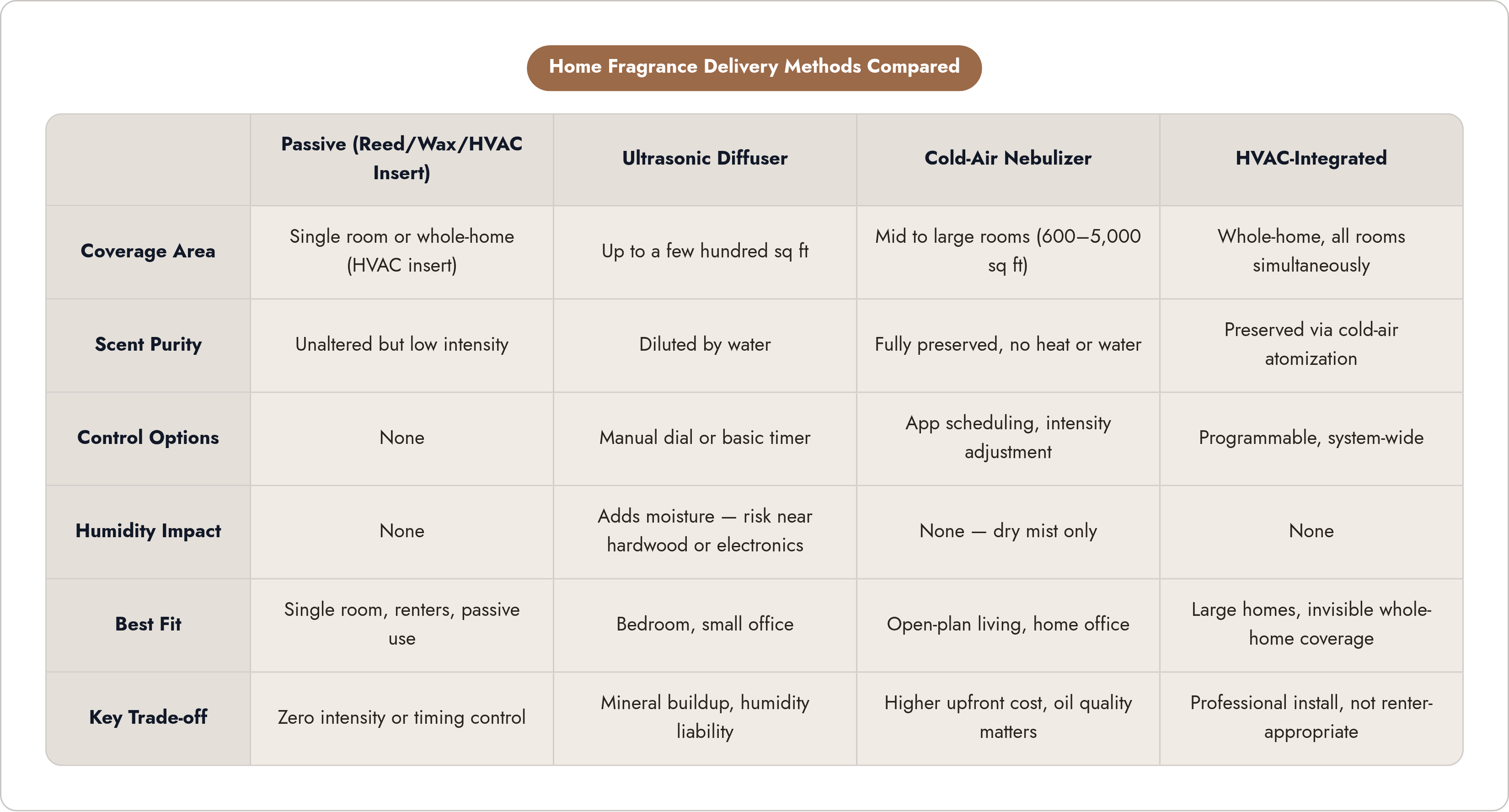
The specs that actually matter when comparing systems across price points
Six criteria apply at every tier. Most buyers consult fewer than three before purchasing, which is where things start going sideways.
Coverage area is the most misunderstood number in the category. A diffuser rated for 600 square feet will not adequately scent a 600-square-foot open floor plan that includes an adjacent kitchen, a hallway, and furniture interrupting airflow. Rated coverage assumes ideal conditions. Real rooms are not ideal conditions.
Scent control spans a meaningful range: a manual dial, a programmable timer, or full app-based smart scheduling. These are different daily experiences, not cosmetic variations. Smart scheduling, specifically running the diffuser only during occupied hours, also trims oil consumption. Convenience feature and cost-control mechanism in one.
Oil compatibility is a long-term purchasing decision dressed up as a one-time spec. Proprietary cartridge systems lock buyers into a single brand's fragrance library at whatever price that brand sets. Open systems accept any compatible oil. That distinction becomes financially significant over months, quietly.
Noise output varies considerably even within cold-air nebulizers. Some run near-silently; others produce an audible hum. Relevant for bedrooms. Often absent from product listings.
Safety profile covers both device behavior and oil formulation. Heat-free and waterless systems carry fewer inherent risks, but fragrance oil composition adds a separate safety dimension relevant to households with children and pets.
Maintenance requirements include cleaning frequency, refill intervals, and cartridge replacement cycles. These are ongoing costs, not one-time specs, and they belong in the purchase calculus from the start.
It is also worth considering what "intensity" actually means as a goal. A well-matched system produces a balanced, consistent atmospheric presence. An oversized diffuser overpowering a small room is as much a mismatch as an underpowered diffuser failing a large one. Getting this right requires working through the specs above before looking at the price tag.
Entry-level options: what under $50 can and cannot do
This tier serves renters, single-room buyers, and people who want to test a fragrance routine before committing real money. All legitimate use cases. The limits are equally legitimate to name.
HVAC filter inserts, such as those from Filtrete, clip onto an existing filter and disperse scent as the system runs, which is whole-home reach at the lowest possible price point. The trade-off: intensity is subtle and contingent on how often the HVAC cycles. In a climate-controlled home running heat or AC regularly, it works reasonably well. In a temperate climate where the HVAC barely runs, it barely works.
Ultrasonic diffusers in the sub-$50 range, brands like ASAKUKI and InnoGear, are effective for single rooms up to a few hundred square feet. InnoGear bundles starter oils, which reduces the learning curve for new buyers. Fine entry points into daily diffuser use, nothing more.
Reed diffusers and conventional plug-in air fresheners require no device cost and no management. The trade-off is zero control over intensity, timing, or coverage. Plug-in air fresheners warrant a specific note: many emit synthetic compounds continuously without interruption, and the long-term indoor air quality implications are a real consideration for households that care about what they're breathing.
What this tier cannot do: smart scheduling, broad coverage, or precise scent control. Ultrasonic models add humidity, which matters in damp rooms or homes with hardwood floors. Oil formulations at this price point are often unverified, with many disclosing only "fragrance" rather than specific constituents.
Best use case: a single bedroom, a small office, or a transitional purchase while a buyer thinks through a longer-term decision. Know what you're buying it for, and it delivers. Expect more, and it doesn't.
Mid-range systems (roughly $50–$200): where smart control and cold-air technology become accessible
This is where the category genuinely inflects. Two meaningful upgrades become available here that are simply unavailable below it: cold-air nebulizing technology and genuine scheduling control. Both change daily performance in ways that accumulate over time.
Cold-air diffusers at this price point atomize pure fragrance oil without water or heat, producing dry, consistent scent across larger rooms. The output is qualitatively different from ultrasonic mist, and the coverage area is meaningfully broader.
Several options are worth examining. Smart waterless diffusers with timer control occupy the upper portion of this tier and serve as solid all-purpose units for living rooms and open spaces. Compact cold-air units with Bluetooth app control, such as those from Air Freshener Solutions including their Gold Hotel & Home Diffuser rated for up to 600 square feet, allow scheduling and intensity adjustment from a smartphone, which is genuinely useful for managing oil consumption and adapting to different daily routines.
Some cold-air diffusers at this tier offer formulations that are vegan, cruelty-free, and ingredient-transparent, designed for cold-air atomization so the scent survives the diffusion process intact. Aura House, a home fragrance brand whose waterless cold-air diffusers pair with clean, non-toxic fragrance oils made for design-forward interiors, sits in this part of the market. Smart scheduling is built in on certain models, and the better-designed systems match output to room size rather than simply maximizing intensity.
One compatibility note worth checking before purchasing: some systems at this tier require brand-specific cartridges. Confirming whether the device accepts third-party oils before buying matters, because that decision carries real long-term cost implications that are easy to overlook at the point of sale.
This tier fits open-plan living rooms, home offices, kitchen-dining combinations, and buyers who want genuine daily control rather than a passive set-and-forget approach.
Premium and whole-home systems (roughly $200 and above): coverage at scale and hands-off consistency
Two distinct approaches exist at this tier, solving different problems. Worth being clear about which problem you actually have before spending.
High-capacity standalone cold-air diffusers, like the Raining AF-11 with a claimed 5,000-square-foot range, exist for large open-plan homes, showrooms, and reception areas where mid-range diffusers lose scent before reaching the far side of the space. Powerful single-source units that produce excellent results in the spaces they're sized for and are overbuilt for anything smaller.
HVAC-integrated systems, such as Airomatica's Black Box rated for up to 4,000 square feet, connect directly to existing ductwork and scent every room at once. The practical effect is the elimination of scent hot spots. That uneven distribution (where one room diffuses actively and the adjacent hallway smells like nothing) disappears.
Aera occupies a different corner of this tier: dry diffusion technology with no mist, no residue, no heat, no water, marketed as hypoallergenic and suitable for households with babies and pets. Cartridges are designed to last up to three months. The trade-off is a closed ecosystem; Aera cartridges are Aera only.
The luxury hotel parallel is worth naming. The signature sensory experience of a high-end hospitality environment (consistent ambient scent with no single detectable source) is not achieved with a cluster of plug-ins on the front desk. It is achieved with HVAC integration or high-capacity cold-air units. The gap between a $30 plug-in and a whole-home scenting system is not a gap in desire; it's a gap in infrastructure.
The honest trade-offs: HVAC installation requires a professional and is not renter-appropriate. Proprietary cartridge systems limit fragrance selection and raise per-use cost over time. Upfront investment is substantial. The payoff is long-term consistency and zero daily management, which, for a large home, is often the only realistic path to even coverage.
How fragrance oil quality shapes the performance of any system, at any price
The device and the oil are a system. A premium cold-air diffuser loaded with a low-quality, undisclosed fragrance blend will produce inferior and potentially irritating results. The device cannot compensate for the oil. This is the part of the purchase most people discover too late.
What "clean fragrance" means in practice: full ingredient disclosure rather than obscuring compounds behind a generic "fragrance" label; formulations free of phthalates, parabens, formaldehyde donors, and synthetic musks; plant-derived carriers rather than synthetic solvents. "Non-toxic" is not a regulatory classification. It reflects a brand's own exclusion decisions, which makes ingredient transparency the only signal a buyer can evaluate independently.
Pet and child safety requires specific scrutiny. Essential oils are plant-derived but highly concentrated, and specific compounds (certain phenols and ketones in particular) are documented as problematic for cats and dogs. A diffuser marketed as family-safe is only as safe as the oils running through it. The device marketing and the oil formulation are separate things, and conflating them is an easy mistake.
Cold-air diffusion amplifies oil quality in both directions. Because the fragrance isn't diluted by water or altered by heat, a well-formulated oil smells truer. A poorly formulated one is harder to disguise. The technology's fidelity advantage becomes a liability if the oil doesn't hold up under scrutiny.
Some fragrance oil lines are formulated specifically for cold-air diffusion: vegan, cruelty-free, safe for people and pets, with published ingredient transparency. The design logic is coherent. If cold-air diffusion preserves the oil's molecular character, the oil's character had better be worth preserving.
Before committing to any system with proprietary cartridges, check whether the brand publishes its ingredient list. Oil lock-in combined with ingredient opacity is a long-term risk that's easy to ignore at purchase and hard to escape afterward.
Matching system to space: the room-size and layout decisions that determine whether a purchase works
Square footage is a ceiling, not a guarantee. A diffuser rated for 600 square feet may underperform in a 600-square-foot layout with hallways, doorways, and furniture interrupting airflow. Rated coverage assumes unobstructed air circulation in a clean rectangular space. Residential layouts are not that, and the rating doesn't volunteer the caveat.
Open-plan spaces require a cold-air diffuser sized for the full area, or HVAC integration. Ultrasonic mist dissipates before reaching the far end of a large room. This isn't a product failure; it's a physics constraint that most product packaging neglects to mention.
Bedrooms and small offices are where ultrasonic diffusers are genuinely appropriate: softer output, lower cost, and the humidity addition is less problematic in a contained, ventilated space. The technology fits the environment.
Multi-room homes present a real fork: multiple mid-range units, one per zone, or a single HVAC-integrated system. The per-room approach offers more granular scheduling flexibility. HVAC integration offers invisible consistency and eliminates the uneven coverage that comes from managing multiple devices. The right answer depends on whether the priority is control or uniformity, and reasonable people land on different sides of that.
Placement within the room compounds device selection. Position the diffuser near the room's primary airflow path, not in a corner where scent pools rather than circulates. Counter height outperforms floor level for cold-air units. Keep the device away from direct sunlight and heat sources, which can alter the oil before it diffuses.
Scent character selection is worth five minutes of thought: welcoming, complex profiles for living spaces; calming, quieter profiles for bedrooms; clean, focused notes for home offices. The right scent character for a space compounds the effect of the right device choice. The wrong one undermines it, regardless of how good the hardware is.
The ongoing costs buyers overlook: oil consumption, maintenance, and cartridge math
The purchase price of a diffuser is the smallest number in the long-term cost equation. Oil consumption is the largest, and it's almost never discussed at the point of sale.
A cold-air diffuser running at medium intensity for four to six hours daily will deplete fragrance oil at a rate that varies by device, oil viscosity, and intensity setting. Most manufacturers publish consumption rates somewhere in their documentation. Most buyers don't read them before purchasing. Running the math before committing to a proprietary cartridge system versus an open-oil system often changes the decision entirely.
Proprietary cartridge systems charge a premium for the convenience of a sealed, pre-filled format. That premium compounds over a year of regular use. Buyers who underestimate ongoing fragrance cost and choose a cartridge system based on upfront device price tend to notice the error by month three or four, and not happily.
Smart scheduling directly reduces oil consumption. A diffuser running only during occupied hours (rather than continuously through the night or an empty workday) can extend oil life by a meaningful margin with no perceptible reduction in the scent experience. This is one of the mid-range tier's most overlooked practical advantages, and it rarely appears in the marketing.
Maintenance requirements vary by technology. Ultrasonic diffusers require regular cleaning to prevent mineral buildup from water, which accumulates faster in hard-water areas. Cold-air nebulizers require periodic cleaning of atomizing components, less frequently and with less residue. HVAC systems require professional maintenance as part of the broader HVAC service cycle. None of these are prohibitive; all of them have a time and occasionally a cost component that belongs in the purchase calculus from the start.
One figure worth calculating before purchasing: cost per year, not cost at checkout. A budget ultrasonic with a two-year pump life and a mid-range cold-air unit with a five-year mechanism represent very different long-term numbers. Run the math before the purchase, not after.