How Cold Air Diffusers Work
Precision nozzles preserve fragrance by skipping heat that degrades delicate top notes.
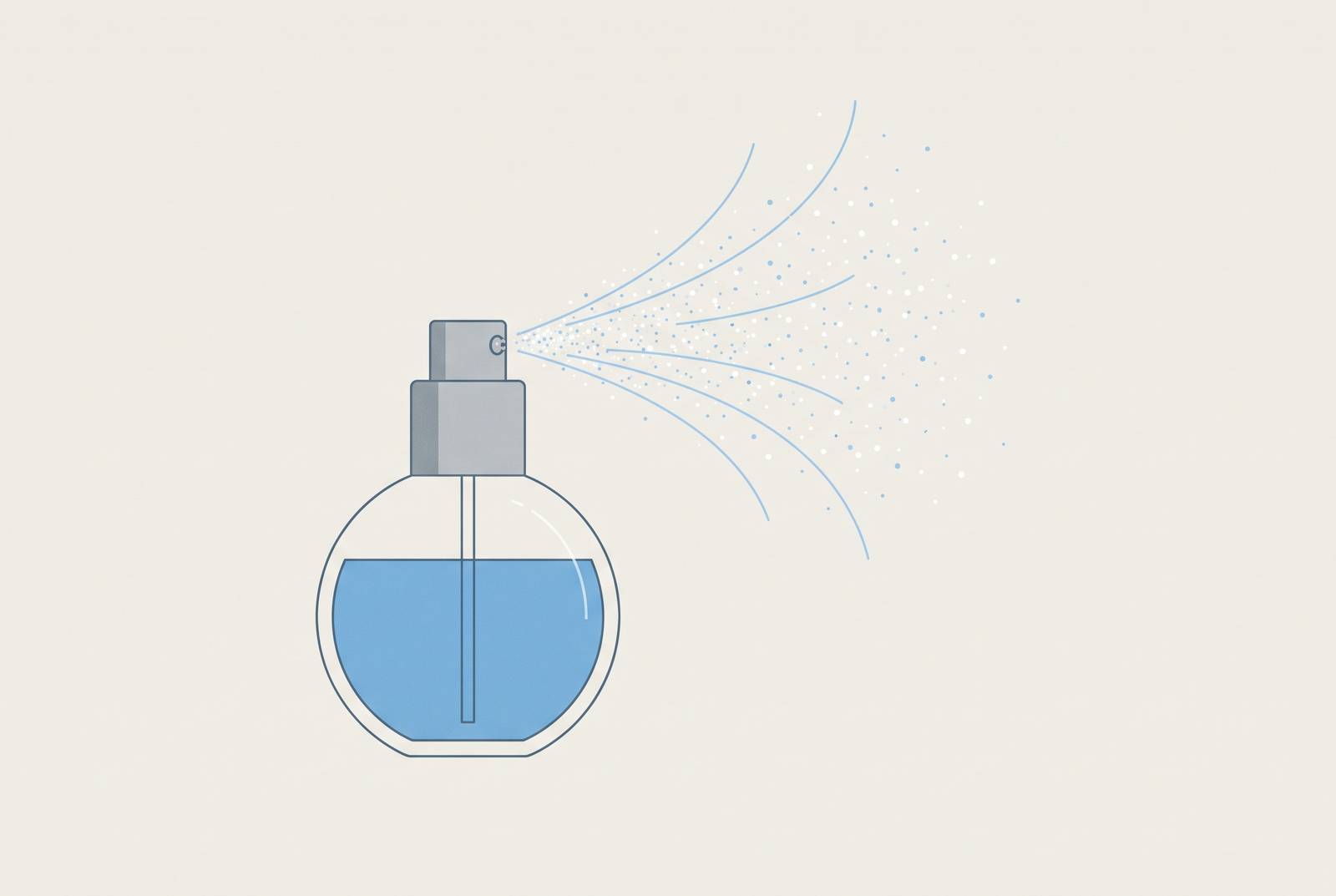
Cold air diffusers turn liquid fragrance into a dry mist using compressed air and a nozzle shaped with more precision than you'd guess from looking at it. No heat, no water, no flame. Just air pressure doing the one thing air pressure is good at, which happens to also be the reason the scent that reaches your nose resembles what the perfumer actually built rather than a warmed-over version of it. This piece walks through the mechanism itself, why skipping heat matters chemically, how the method stacks up against ultrasonic and wax-melt approaches, and what all of that means for the oil you buy and the buttons you actually press at home.
The category's growth backs up the interest: the global diffuser market hit $1.5 billion in 2024 and is projected to grow at 11.3% annually through 2026, the fastest pace of any home fragrance segment. A 2025 Mintel survey found 56% of diffuser buyers chose diffusers over candles specifically because there's no open flame. NPD Group data from the same year shows people buy these for personal enjoyment (68%) and ambiance (54%). People have decided they want their homes to smell like something intentional. What they haven't sorted out is which machine should be doing that job, and it turns out the machine changes the outcome more than the marketing copy on the box would suggest.
What happens inside a cold air diffuser from the moment it turns on
Flip the switch and a small pump starts pulling in room air. That air passes through a filter first, getting stripped of dust and whatever else is floating around your living room, before it ever touches a drop of oil.
Then the filtered air gets compressed and forced through a precision nozzle at high velocity. Here's the actual trick: fast-moving air creates a pressure drop, and that drop pulls oil upward into the stream, where it gets sheared apart into a fine mist. This is the Venturi effect, the same principle running a carburetor or an old perfume atomizer, the kind with the little rubber bulb your grandmother probably owned. Fast air, low pressure, liquid gets yanked in and shattered into pieces too small to see. No moving parts to speak of, nothing that needs a manual thicker than a postcard.
What comes out the other end is a mist made of particles between 1 and 5 microns. At that size, the particles stop acting like a liquid and start acting more like a gas: they hang in the air instead of falling and pooling near the base of the unit, the way a heavier mist would. No water enters the process at any point. No heat touches the oil, ever. Nothing is burning. It's just air, pressure, and oil, arranged in a shape that makes physics do the work.
Why atomizing oil without heat preserves the scent the perfumer intended
Fragrance oils are layered compositions, built from top notes, middle notes, and base notes, and each of those layers has its own volatility and its own patience for heat. Top notes especially don't hold up well. Push the temperature past roughly 40°C and you can lose 30 to 50 percent of their potency, which means what reaches your nose is already a diminished version of what the perfumer sat down and formulated in the first place.
Cold air diffusion never raises the oil's temperature, so it never has that problem. The full profile, top to base, reaches the room the way it left the bottle. Perfumers call this a "true note," meaning the scent as designed rather than the scent as cooked down. It's a distinction that sounds pedantic until you're dealing with a complex blend or a single-origin extract, where the entire point is how the notes relate to each other rather than any one note carrying the show by itself.
Why should someone who just wants their apartment to smell good care about any of this? Because a scent built to unfold in stages, top note first, then heart, then base, needs all three stages intact to actually do that. Heat doesn't just turn the volume down; it can cut whole instruments out of the mix. And this is where oil quality starts mattering in a way we'll circle back to later, because a delivery method this faithful to the original formula is also faithful to whatever's actually in the bottle. Good or bad.
How cold air diffusion compares to ultrasonic, heat-based, and passive methods
Every alternative makes a trade somewhere. Worth naming them plainly rather than pretending cold air is the only method that's ever worked for anybody.
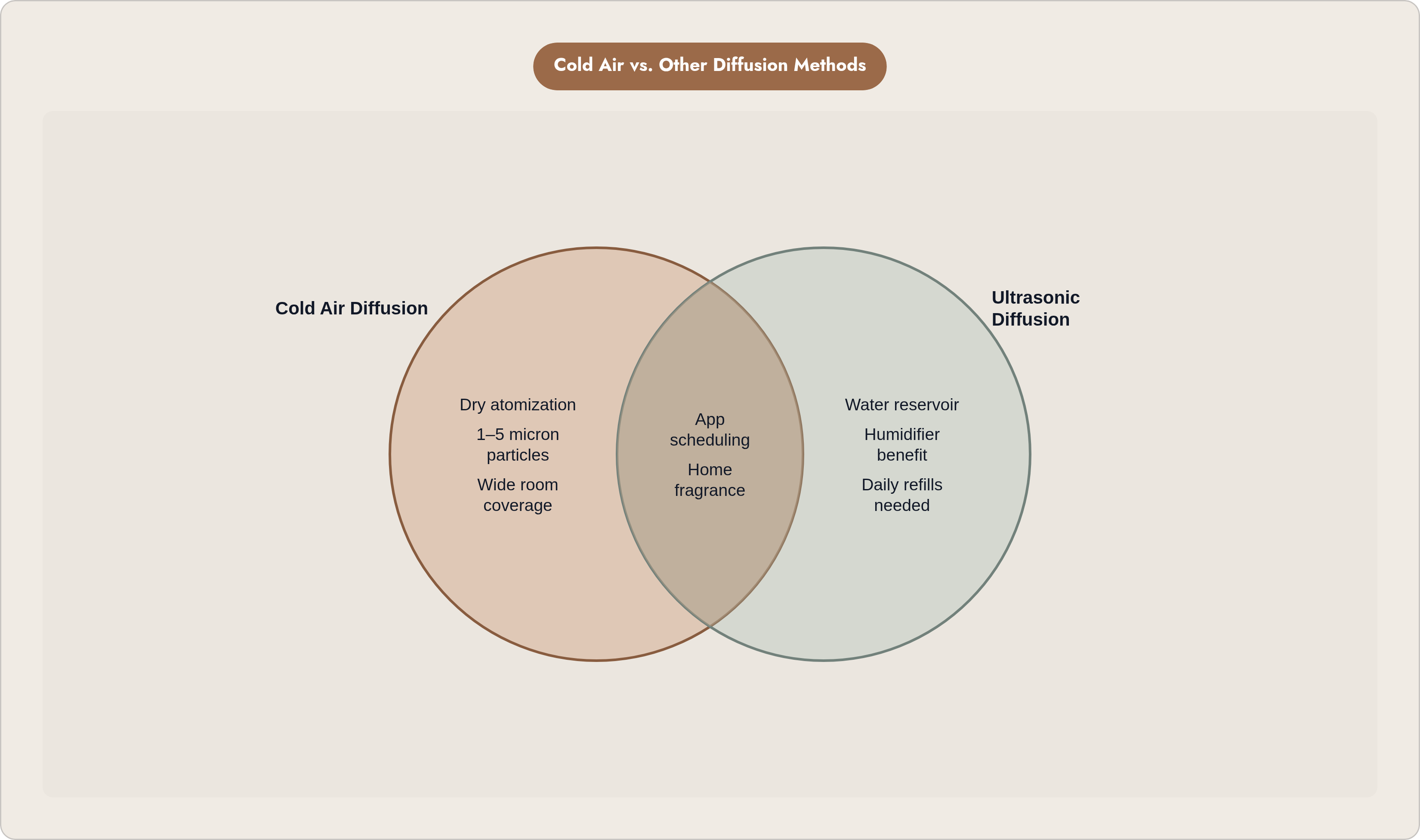
Ultrasonic diffusers use high-frequency vibration to push oil through water into the air. That dilutes the oil before it goes anywhere, and the device is basically moonlighting as a humidifier, genuinely handy if you live somewhere dry. But scent strength ends up tied to how much water you added, there's a faint hum or bubble while it runs, and the reservoir needs a fresh fill daily or you're growing something in the tank you'd rather not think about. Heat-based diffusers and oil warmers run straight into the degradation problem from the last section: scent peaks fast, then fades as the compounds cook off or break down. Reed diffusers and sprays are passive and one-shot; no control over timing or intensity, coverage limited to a few feet, and reeds slow down and saturate the longer they sit.
Candles are burning something, so you get particulates riding along with the fragrance, an open flame in a house that may contain a toddler or a curious cat, and scent distribution that depends on heat convection instead of anything even.
Cold air diffusion skips each of those specific problems. Nothing diluting the oil, nothing cooking the compounds, no flame and no combustion byproducts, and the whole thing runs close to silent. Maintenance is lighter too, no daily water swaps, no heating element collecting gunk. Coverage runs wider as well; cold-air units can fill spaces roughly twice the size that candles, reeds, plug-ins, and ultrasonic units typically manage.
None of this makes ultrasonic diffusers a bad choice. They're cheaper, they help in dry climates, and a small bedroom might genuinely prefer a gentler, water-cut scent. This isn't about crowning a winner so much as showing that the mechanism changes the result in ways you can actually measure. Some cold air diffusers fit into this comparison as working examples of the approach: dry atomization, disclosed oil formulas, quiet motors, scheduling through an app, essentially the same method used to scent hotel lobbies, shrunk down to fit a living room.
The hotel lobby effect: why consistent scent distribution is a function of particle size and airflow
You've had this experience even without clocking why it happens. Walk into a nice hotel lobby and the fragrance is just even. Not a wall of it by the revolving door, not nothing by the elevators, not some cologne cloud pooling in a corner near the vent. Same everywhere, which is a stranger trick than it sounds like.
That evenness is a mechanism, not an expensive oil. The 1 to 5 micron particles from cold air diffusion stay suspended instead of settling near the source, so instead of drifting down the way a heavier mist would, they get picked up by whatever air is already moving through the room, the HVAC, the convection currents, someone walking past with a coffee. The mist behaves like a gas filling a container rather than a liquid pooling under a spout.
That same physics scales down to a living room, which raises a fair question: is the mechanism ever actually the bottleneck, or is it usually just the setup? Almost always the setup. Underpower a big room and you get patchy coverage no matter how good the atomization is; overrun a small bedroom and you've made a scent bomb. Matching output to square footage is the entire game once you accept that the tech itself is already capable of the lobby trick; it's not withholding anything from you.
What the oil going into a cold air diffuser actually needs to be
Here's the catch with a delivery method this honest: it's honest about everything, not just the pleasant parts. Because the oil leaves the nozzle undiluted and unheated, whatever's actually in the bottle reaches your lungs in its full chemical form. No thermal breakdown softening it on the way out, no water cutting it down. That makes what's actually in the formulation matter more here than it does for heat or water-based methods, where some fraction of the compound never really makes it into the room to begin with.
Regulators have caught up to this. The EU expanded its list of declarable fragrance allergens from 26 compounds to more than 80 under Regulation (EU) 2023/1545. IFRA's updated Transparency List now covers over 3,000 ingredients, a level of disclosure you'd expect on a prescription insert, not a candle label. That's not bureaucratic overreach for its own sake; roughly one in five people is sensitized to at least one allergen, and fragrance allergy specifically affects somewhere between 2 and 11 percent of people worldwide, depending on the study. Put an undiluted compound profile into a closed room and those percentages stop being an abstract line in a report.
There's a mechanical wrinkle too. Not every oil is built for nebulization; carrier-heavy or water-containing blends can clog a nozzle or spit an inconsistent mist, undoing the precision the whole device is built around. And because cold air diffusion is so efficient at getting oil into the air, you have to think about who else is breathing it: certain essential oils are genuinely dangerous to cats and dogs even in tiny concentrations, easy to forget when you're just trying to make the hallway smell like cedar and vanilla. Some oils are formulated specifically for cold air systems, with disclosed ingredients and nothing exotic hiding in the mix, so the mechanism's honesty works for you instead of against you.
The controls that turn the mechanism into a manageable home experience
A mechanism this efficient needs a leash. Left alone, cold air diffusion would over-scent most rooms within the hour, so the controls around it aren't a bonus feature for the app store screenshot. They're the difference between a pleasant room and a headache.
Intensity adjustment is the first lever: pump output and nozzle settings decide how much mist actually leaves the device, which lets you dial fragrance strength to the room or the mood instead of buying new oil every time you want something subtler. Scheduling matters just as much. Timers and app controls let the diffuser cycle on and off, which does two things: it keeps your nose from going numb to a smell it's been marinating in for six hours straight (a real, documented thing called olfactory fatigue), and it stretches how far a bottle of oil goes. Voice and app compatibility round this out, smart home integration is now one of the bigger drivers at the premium end of this market, mostly because it lets scheduling happen in the background instead of requiring you to remember anything before 8am.
Maintenance is lighter than the ultrasonic side of things too: no reservoir to empty and disinfect, no heating element to descale, just an occasional wipe of the nozzle and oil chamber to keep the mist consistent. Placement matters more than people expect, honestly. A diffuser near an air return or in a central hallway gets a free push from the home's existing airflow; one wedged behind a couch in the corner is quietly wasting most of what it's capable of. The device gives you a genuinely strong tool here. Where you put it and how you schedule it decides whether it performs the way it's built to, or just sort of put