Diffuser Setup, Cleaning, and Troubleshooting
How Many Drops of Essential Oil in a Diffuser?
The number printed in your diffuser's manual beats any chart. Here is how to find a starting point when it gives none, and how to tune it for your room.
Guide by Home Diffuser Review Editors ·
The short answer
For a water-based (ultrasonic) diffuser, use the drop count in its manual. When the manual gives a range, start at the low end. When it gives nothing at all, start with 2 to 3 drops per 100 ml of water, the low end of the guidance diffuser makers commonly print (it usually sits somewhere between 2 and 5 drops per 100 ml), and add one drop at a time on later fills until the room smells the way you want.
Waterless diffusers don't take drops at all. Cold-air and nebulizing models draw oil straight from a bottle or reservoir, so you control strength with the output and timer settings, not by counting.
Whatever the diffuser, run it intermittently: 30 to 60 minutes on, then 30 to 60 minutes off. That rhythm comes from the Tisserand Institute's diffusion guidelines, and it matters as much as the drop count.
It depends on the kind of diffuser
How oil gets into the air decides whether "how many drops" is even the right question.
| Diffuser type | How the oil goes in | Where to start |
|---|---|---|
| Ultrasonic (water-based) | Drops added to water, filled to the line | The manual's figure; if none, 2 to 3 drops per 100 ml |
| Cold-air / nebulizing (waterless) | Undiluted oil, straight from a bottle or reservoir | No drops: lowest output and shortest interval, then adjust |
| Heat or evaporative pad | Drops on a pad or dish | The maker's figure; a few drops is typical |
| Reed diffuser | Oil poured into the vessel | No drops: add or remove reeds to change strength |
If you are not sure which kind you own, our home diffuser types compared explains how each one works.
Ultrasonic diffusers: scale with the tank
An ultrasonic diffuser turns water and oil into a fine mist, so the oil is diluted by however much water the tank holds. That is why guidance is given per 100 ml: a bigger tank needs proportionally more oil to smell the same.
To scale it, find your tank's capacity (it is on the box, in the manual, or marked by the fill line) and multiply. If your manual is silent, this is what the common 2 to 5 drops per 100 ml range works out to. Start at the low number:
| Tank capacity | Starting point (low end) | Upper end of common guidance |
|---|---|---|
| 100 ml | 2 drops | 5 drops |
| 200 ml | 4 drops | 10 drops |
| 300 ml | 6 drops | 15 drops |
| 500 ml | 10 drops | 25 drops |
Two practical notes:
- Fill with water first, then add the oil, unless your manual says otherwise. Counting drops into a measured amount of water is what keeps the strength repeatable.
- Don't fill past the max line to stretch the oil further. The drop count assumes the tank is filled to that line, not beyond it.
Waterless diffusers: adjust output, not drops
Cold-air and nebulizing diffusers break undiluted oil into a fine spray without heat or water (how cold-air diffusers work). Because nothing dilutes the oil, they are stronger for the oil they use, and a "drop" count does not apply: the diffuser draws what it needs from the bottle.
- Start on the lowest intensity and the shortest run interval your model offers, then raise one setting at a time over a few days.
- Use only oils the maker approves for the unit. Thick or mismatched oils can clog the nozzle; see fragrance oil vs essential oil in a cold-air diffuser.
- How long a bottle lasts depends on the model, the settings and the oil, so check the maker's own figure for your unit rather than a general estimate.
What changes the right number for your room
The manual's figure assumes an average room. Adjust from it for:
- Room size and layout. An open-plan living area needs more output than a closed bedroom. Matching the diffuser to the room usually works better than adding more oil; see best oil diffusers for large rooms.
- The oil itself. Some oils smell much stronger than others at the same drop count. With a new oil, start at the low end again.
- Blends. The total stays the same. If you would use 4 drops of one oil, a two-oil blend is 2 and 2, or 3 and 1, not 4 of each.
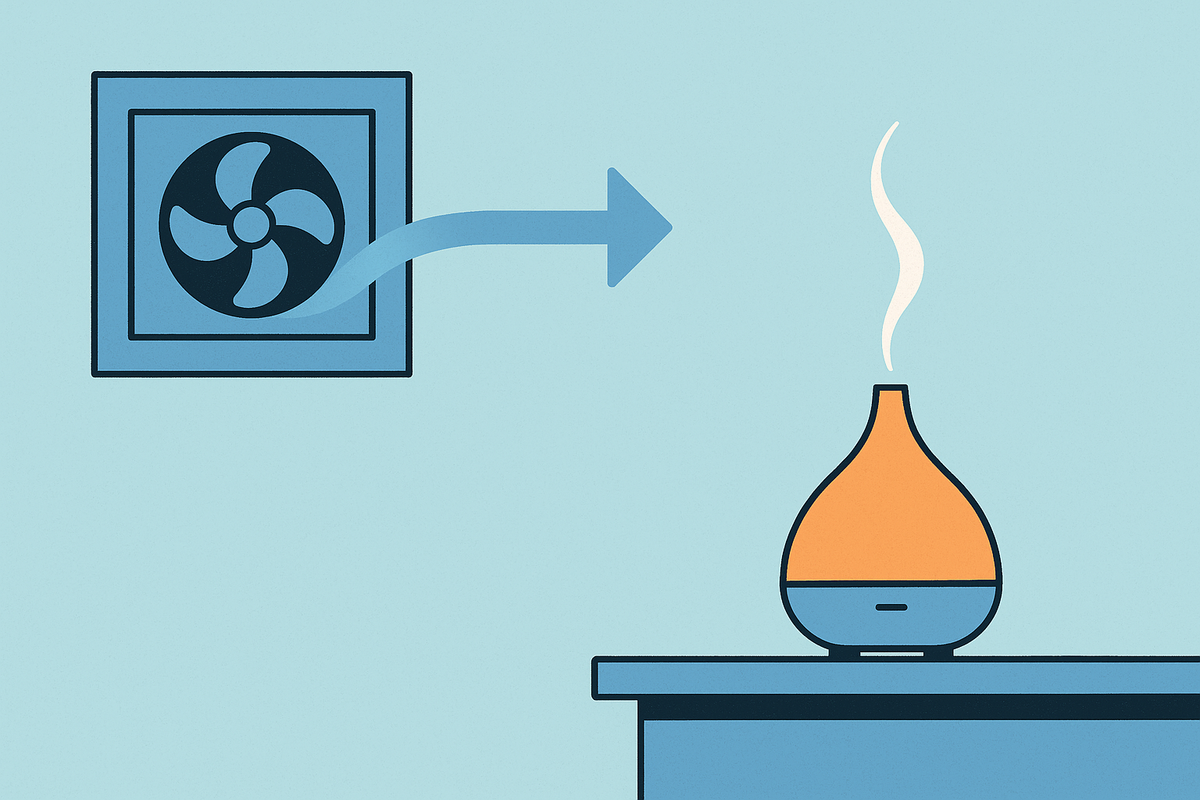
- Airflow. A window, a fan or a heating vent carries scent away faster. Good airflow is still worth keeping; our guide to ventilation for safe indoor diffuser use explains why.
- Who shares the room. Children, pregnant people, anyone with asthma, and pets (cats and birds especially) call for fewer drops, shorter cycles, and a way to leave the room. Read the diffuser safety section, and ask your doctor or vet first if you are unsure.
Signs you are using too much
Back off a drop or two, or shorten the run time, if you notice:
- a headache, a scratchy throat or watery eyes;
- scent that lingers on fabrics or in the room long after the diffuser stops;
- an oily film on surfaces near the diffuser, or a greasy tank that needs cleaning more often than usual.
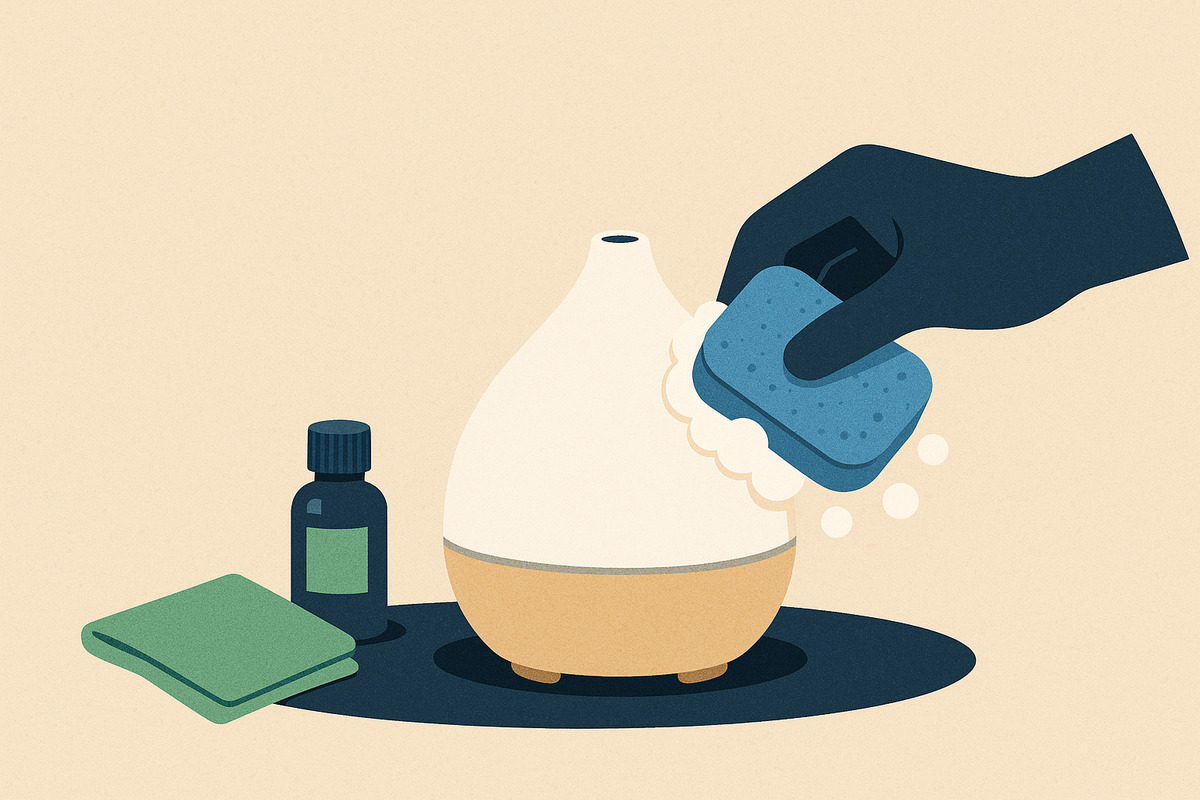
Residue in the tank also mutes the scent over time, which tempts people to add more oil. Often a clean is the fix: here is how to clean an essential oil diffuser step by step.
Why you stop smelling it (and shouldn't add more)
After a while your nose adapts to a steady scent and stops registering it, even though the oil is still in the air. Adding drops in response just builds up more in the room. Let the off-cycle run instead: when the diffuser comes back on, you will notice the scent again. A diffuser with an interval timer does this for you.
Common questions
Is 10 drops too much for a diffuser?
It depends on the tank. Ten drops sits at the upper end of common guidance for a 200 ml ultrasonic tank and at the lower end for a 500 ml one. In a small 100 ml unit it is about double the usual upper figure. Check your tank size and your manual.
How many drops for a small diffuser?
Small personal and desk diffusers often hold around 100 ml or less. Start with 2 to 3 drops, or the manual's figure, and adjust from there.
How long should I run a diffuser?
In cycles: 30 to 60 minutes on, then 30 to 60 minutes off, per the Tisserand Institute. Very faint diffusion, where the oil is barely noticeable, can run longer. Running a strong diffuser all night is not recommended; our ventilation guide covers bedrooms.
Does a drop of one oil equal a drop of another?
Not exactly. Drop size depends on the bottle's dropper and how thick the oil is, so a "drop" is a rough measure. That is another reason to start low and adjust by smell.