Fragrance Oil vs Essential Oil in a Cold Air Diffuser
Fragrance oils outperform essential oils in cold air diffusers due to viscosity and stability.

A cold air diffuser works by driving pressurized air through a narrow chamber where it meets the oil, shattering it into a fine mist through an atomizing nozzle or disc, then expelling that mist into the room. No heat, no water. Because the oil is not cooked, its original chemical profile reaches you largely intact. Top, middle, and base notes arrive in roughly the ratio they were formulated to, which is why cold air diffusion produces a more faithful scent rendering than heat-based methods that volatilize lighter compounds before the oil even clears the reservoir.
The atomizer is calibrated to a specific viscosity range, and that constraint dictates everything downstream. Too thick, and the oil cannot be broken into sufficiently fine droplets; the nozzle clogs, or the mechanism strains. Too thin, and atomization becomes erratic, scent throw collapses, coverage suffers. Neither failure is dramatic. Both manifest as gradual degradation, which is the worst kind because it is so easy to blame on something else. The diffuser, the room size, the season. Rarely the oil.
Why Many Essential Oils Create Problems Inside a Cold Air Diffuser
Essential oils vary enormously in viscosity depending on plant source and chemical composition. Light oils, citrus, eucalyptus, tea tree, sit closer to a workable range. Heavier ones, sandalwood, vetiver, patchouli, are significantly more viscous than most cold air atomizers are designed to handle. Resinous compounds accumulate inside the nozzle even when the oil initially flows without protest, creating blockages that worsen progressively and quietly.
There is also a volatility problem. Essential oils are naturally high in volatile aromatic compounds, and in therapeutic contexts, that volatility is the feature. In a cold air diffuser built for sustained room coverage, faster volatility means shorter scent duration. Pure essential oils carry no fixatives, nothing to extend throw or preserve aromatic character over time. The room fills, then clears faster than the device's design anticipates.
The cumulative result: inconsistent atomization, accelerated nozzle fouling, more frequent cleaning cycles, and with heavier or resinous oils, potential mechanical wear. Lighter essential oils fare considerably better than heavier ones, but that nuance rarely appears on the diffuser's packaging. Most people discover it only after the nozzle has already lodged its complaint.
What Makes a Fragrance Oil Well-Suited to Cold Air Diffusion
Not every fragrance oil qualifies. Standard fragrance oils designed for ultrasonic diffusers or candle-making are often too thick for cold air nebulization. The terms "waterless-formulated" or "cold-air-compatible" are meaningful technical specifications, not marketing decorations. They indicate specific formulation decisions made to match the oil's viscosity to the atomizer's operating range.
Stability is engineered in, not assumed. A well-formulated cold-air-grade fragrance oil includes fixatives that extend scent throw and keep the aromatic profile consistent across the life of the bottle. With a pure essential oil, lighter volatile compounds tend to escape faster than heavier ones, meaning the scent character can shift as the bottle empties. A properly made fragrance oil is designed to deliver top, middle, and base notes in proportion throughout use, because that balance was formulated and then stabilized.
Residue-free atomization is similarly a formulation-level specification, not an incidental outcome. That specification is the right thing to be looking for, regardless of which brand you're evaluating.
The Safety Question: What Clean Actually Means for a Fragrance Oil Used in a Cold Air Diffuser
The common assumption runs something like this: essential oils are safe because they are natural, fragrance oils are suspect because they are synthetic. It is a tidy binary. It is also wrong on both sides.
Adulteration is a documented problem in the essential oil market. Diluted or synthetically extended oils appear regularly in the literature, and some adulterants carry real toxicity concerns. Several essential oils cause direct physiological harm to pets even at diffused concentrations. Photosensitizing compounds in citrus oils, high phenol content in oregano and clove, these are not edge cases. "Natural" is not a synonym for "safe."
What makes a fragrance oil clean is more documentable than most people expect. IFRA compliance, meaning adherence to the International Fragrance Association's concentration safety standards, currently in its 51st Amendment as of early 2025, provides specific maximum safe limits organized by application type. Phthalate-free formulation addresses a legitimate concern; phthalates are plasticizing compounds sometimes used in fragrance development, and their presence in an inhalable product warrants scrutiny. Paraben-free and formaldehyde-free formulations are additional markers worth looking for. Critically, IFRA certificates should be available as actual documents from the supplier, not gestured at with a vague "meets safety standards" line on a product page.
The real risk category is cheap, unregulated fragrance oils containing volatile organic compounds, industrial solvents, or phthalates at concentrations inappropriate for indoor air diffusion. These are sourcing and quality failures, not inherent properties of the fragrance oil category. The FDA currently allows fragrance ingredient formulas to remain proprietary, making ingredient transparency voluntary. That makes a brand's willingness to publish IFRA certificates and disclose clean ingredient standards a meaningful signal, not a nice-to-have.
The practical safety framework is not the natural/synthetic binary. It is IFRA-compliant formulation, phthalate-free ingredients, and appropriate diffusion intensity in a ventilated room.
How Pets Change the Oil Safety Calculation in a Cold Air Diffuser Home
Pets metabolize aromatic compounds differently than humans. This is physiology, not precautionary overstatement, and it changes the calculation in ways that are worth taking seriously before you fill the reservoir.
Cats lack certain liver enzymes needed to process specific aromatic compounds present in essential oils, making them vulnerable to toxicity from diffused exposure, not just topical contact. VCA Hospitals flag tea tree, eucalyptus, peppermint, and several citrus oils as problematic for cats. Dogs are metabolically more robust in this area but have olfactory sensitivity that vastly exceeds a human's, and tea tree, cinnamon, citrus, pennyroyal, and pine-based oils appear on veterinary guidance lists as harmful to the species.
The same properties that make cold air diffusion systems effective for room coverage, finer particle size and broader dispersion, also mean pet exposure is more consistent and harder to avoid in a shared living space. A cat that eventually relocates to another room has still spent hours in a finely diffused environment before deciding to leave.
A well-formulated, IFRA-compliant fragrance oil used at appropriate intensity in a ventilated space is generally a more defensible choice in a pet household than diffusing concentrated essential oils known to be problematic for that species. "Pet-safe" on a label is a starting point, not a conclusion. It is a function of specific ingredients, concentration, ventilation, and the animal's ability to exit the diffused space. Start at low diffuser intensity, allow pets access to unscented rooms, and select fragrance oils with disclosed, verifiable ingredient standards.
Where Essential Oils Still Earn Their Place, and What That Means for How You Use Each Product
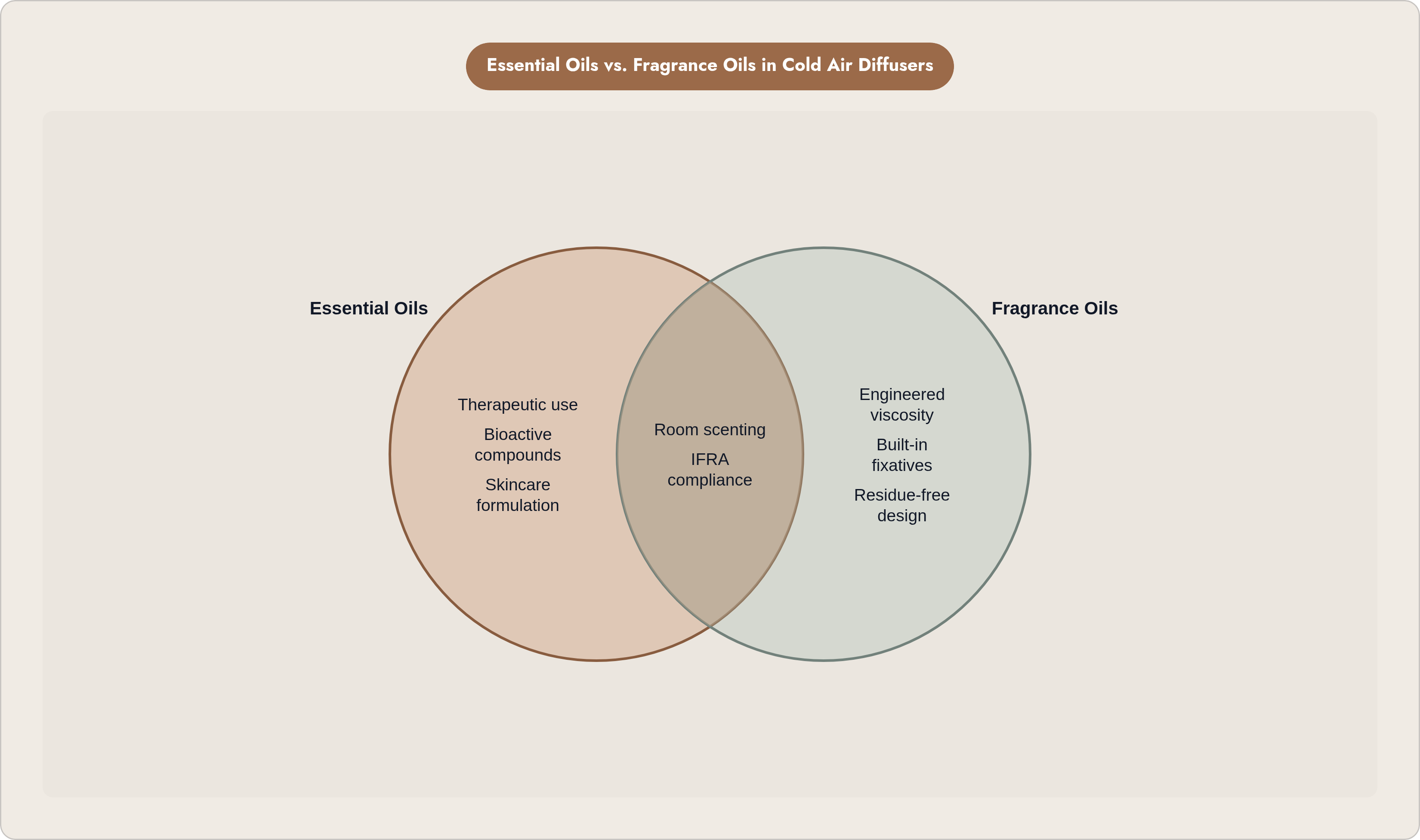
Treating essential oils and fragrance oils as competitors misses the point. They are not the same product with different price tags. They are different tools built for different jobs.
Essential oils have genuine therapeutic applications that fragrance oils do not replicate. A randomized controlled trial published in Frontiers in Psychology found lavender essential oil associated with reduced anxiety in patients awaiting minor surgery. Research published in the International Journal of Environmental Research and Public Health found rosemary aroma associated with improved speed and accuracy on cognitive tasks. Studies on bergamot and ylang-ylang have appeared in peer-reviewed literature examining mood and sleep outcomes. These effects are tied to bioactive compounds in the oils themselves, compounds that are not the goal of a fragrance oil formulated for room scenting, and should not be expected from one.
It is also worth considering an emerging complication: fragrance manufacturers are increasingly developing blends with mood-directing intent, organizing aromatic profiles around aromatherapy research even without making therapeutic claims. dsm-firmenich has published consumer research suggesting a substantial proportion of fragrance users view scent as important for mood regulation. Whether fragrance oil collections organized around mood or ritual deliver a meaningful wellness function, or whether that framing is primarily commercial scaffolding around a room-scenting product, is a question the category has yet to cleanly answer.
The line is blurring from both directions. Essential oils are being packaged with lifestyle positioning, fragrance oils are borrowing aromatherapy language, and the consumer is left to sort out which claims are substantive and which are atmospheric. Use essential oils for therapeutic aromatherapy, personal wellness practice, and skincare formulation, contexts where the bioactive chemistry is the point. Use fragrance oils for consistent room scenting, broader creative scent palettes, device longevity, and large-area coverage.
How to Choose the Right Oil for Your Cold Air Diffuser Without Getting It Wrong
Start with the device manufacturer's guidance, not as a formality but as an engineering specification. Cold air diffusers are calibrated for a viscosity range, and oils outside that range tend to produce nozzle fouling, inconsistent mist, or mechanical wear. If the manual specifies fragrance-oil-only or waterless-formulated oils, that is a technical requirement, not a upsell suggestion.
From there, the selection criteria are specific.
Labeled cold-air-compatible or waterless-formulated. Generic fragrance oil and ultrasonic-grade oil are different products. The application matters more than the label aesthetics.
IFRA-compliant, with the certificate available as a document. A claim is a starting point. A certificate is documentation. Ask for the paperwork; a legitimate supplier will have it.
Phthalate-free, paraben-free, formaldehyde-free. Explicitly stated, rather than implied by a "clean" label with no supporting specification underneath it.
Ingredient transparency, especially in households with children or pets. Disclosure is voluntary under current FDA rules, which makes its presence a meaningful signal rather than standard practice.
Matched to your diffuser's rated coverage area. A heavier oil in an underpowered diffuser tends to underperform regardless of the scent profile. Match the oil's performance parameters to the device's specifications.
But what if you have already been using the wrong oil for months? The degradation is slow enough that most people do not connect it to the oil at all. They assume the diffuser is aging, the room is too large, the season too dry. Three months of wrong inputs looks a lot like a diffuser that just stopped working. Often, it is not.
Oil selection for a cold air diffuser is a technical decision that also happens to be a sensory one. Get the technical part wrong, and the sensory part rarely has a chance.