Home Diffuser vs Reed Diffuser for Bedrooms
Reed diffusers excel at safety and silence, but lack intensity control.

A bedroom is different from every other room in the house when it comes to diffuser choice, because the metrics that matter in a living room (throw, visual appeal, how it smells when guests walk in) get replaced by a completely different checklist once the lights go out.
Four constraints separate bedroom use from everywhere else in the house, and they're worth naming before comparing any products at all. Continuous overnight presence matters since nobody's getting up at 2 a.m. to flip a switch, zero noise tolerance is essential because a hum that's inaudible in a kitchen becomes a small, persistent irritation at 3 a.m. when the HVAC clicks off and the room goes dead silent, safety with your eyes closed rules out anything involving an open flame or a heat source you can't monitor, and low maintenance counts too since nobody wants a nightly refill ritual added to their already-negotiated bedtime routine. Bedrooms are also sealed, climate-controlled boxes with minimal air movement, so fragrance lingers longer and any miscalculation in intensity compounds instead of dissipating out an open window. Partly for this reason, functional fragrance, scents marketed specifically for sleep and calm, grew 23% year-over-year across North America and Western Europe in 2025. The bedroom is where that growth is happening, and it's worth understanding why before you buy anything.
How reed diffusers work and what that means for a sleeping space
The mechanic is simple: rattan or fiber reeds sit in a bottle of fragrance oil, capillary action pulls the oil upward through the reed's internal channels, and it evaporates off the exposed surface into the room. There's no power source, no moving parts, no chip inside deciding when to turn on. It runs quietly and continuously, with no flame and nothing that can tip over and start a fire.
Run that mechanic against the bedroom checklist and reed diffusers score well on three of four points almost by default. Continuous presence is guaranteed since passive evaporation doesn't know how to switch off, noise is a non-issue since there's no transducer, no fan, nothing that could hum even if it wanted to, and safety is close to absolute once the reeds are placed since there's no heat and no electrical component anywhere in the system.
Where it falls short is intensity control, and this is the limitation that actually matters. What you set up on day one is what you get every night after, with no dial to turn down on the evening your sinuses feel raw or your partner mentions the room smells too strong. Reed diffusers also have a real coverage ceiling: they're built for small to medium rooms, and a large master suite with a walk-in closet attached can sit right at or past their effective range. On the plus side, premium formulations can last up to five months per bottle, which is a maintenance win worth remembering later in this piece. There's also a real pattern worth noting: in an air-conditioned bedroom overnight, the cooler air slows evaporation, so scent output drops slightly while you sleep, then lifts again as warmer morning air moves through the room.
How electric home diffusers work and what their controls mean overnight
Electric diffusers split into two camps that behave very differently once you're trying to sleep near one. Ultrasonic models use a ceramic disc vibrating at high frequency to turn water and a few drops of oil into a fine mist. Cold-air nebulizing models skip the water entirely, using air pressure alone to atomize pure oil into the room. That distinction, water versus no water, turns out to matter more than most product pages let on.
The controls are a real selling point here, and reed diffusers simply have no answer for them. A timer with auto-shutoff lets you run the device for a 30- to 60-minute wind-down window and then stop, rather than diffusing all night uninvited; intensity adjustment means you can dial output down on a sensitive night instead of just living with whatever the bottle gives you; and interval scheduling, cycling the device on and off in programmed bursts, does double duty, stretching the oil further while keeping your nose from tuning the scent out completely (more on that phenomenon in a few sections).
Against the four-point checklist, electric diffusers are a mixed bag, and that's the honest takeaway. Continuous overnight presence is achievable but requires setup, either configuring a timer correctly or accepting that the unit runs unattended till morning. Noise is where standard ultrasonic units lose points: that faint hum and occasional gurgle, invisible in a spec sheet, becomes noticeable the moment the rest of the house goes quiet. Cold-air nebulizers vary by build quality but tend to run quieter. Safety is generally fine, with no open flame in either camp, though ultrasonic mist settling near electronics on a nightstand is worth a second thought. Maintenance is the ultrasonic format's weak spot, which gets its own full treatment two sections from now. One underrated bonus: plenty of ultrasonic models double as a dim ambient light for readers who want a little glow during their wind-down chapter. Just remember you need an outlet nearby, and cord length quietly dictates where the whole device can live.
Coverage, room size, and where each format reaches its ceiling
Match the diffuser to the square footage before you worry about anything else, because that's the rule that sounds obvious until you realize how often people skip it.
Reed diffusers top out at small and medium rooms. A large primary bedroom, especially one with high ceilings or an attached sitting area, tends to sit right at or past their reach; the reeds simply can't move enough oil to fill that volume. Standard ultrasonic electric diffusers push further than reeds do, though exact range shifts by model and by how open the floor plan is. Cold-air nebulizing systems represent a genuinely different tier: models engineered for residential use typically cover 800 to 1,200 square feet from a single unit, a range neither reed nor standard ultrasonic formats can touch.
This distinction matters specifically for bedrooms because a primary suite is rarely just one box of air. Add a walk-in closet, an ensuite bathroom, maybe a reading nook, and you've got a multi-zone space where a reed diffuser tucked in one corner never reaches the far end. High ceilings slow distribution further, since fragrance has more vertical volume to climb before it reaches your nose at pillow height. The flip side deserves equal attention: in a small guest room or a compact bedroom in an older apartment, running a cold-air unit at full output would blanket the room in scent within minutes. That's precisely why intensity control and interval scheduling matter on a large diffuser. They're the safeguard that keeps a powerful tool from overwhelming a small room.
The overnight safety question: oil chemistry, ingredients, and what happens while you sleep
Here's where the bedroom's sealed, low-ventilation nature stops being a quirky detail and starts being the whole point. Whatever a diffuser releases into that air has nowhere to go for eight hours. In a living room with foot traffic and open doors, chemical buildup dilutes. In a bedroom overnight, it accumulates, which raises the stakes on exactly what's in the bottle.
The word "fragrance" on an ingredient label covers more territory than most people realize. It's a catch-all term covering more than 3,000 synthetic compounds, and research from the EPA and the NRDC has linked various of these to respiratory irritation and hormonal disruption. This isn't a reason to panic, but it is a reason to read past the word "fragrance" and ask what's actually inside, especially with cheaper reed oils and conventional plug-in cartridges where "phthalate-free" reformulations don't automatically mean the replacement ingredients have been studied any more thoroughly.
One nuance worth sitting with: even natural, "clean" scents aren't automatically exempt. Terpenes, the aromatic compounds found in plenty of essential oils, can react with indoor ozone to form secondary nanoparticle pollution. No format gets a total pass here, reed or electric, natural or synthetic. What clean actually looks like differs by format. For reed diffusers, it means non-toxic carrier oils, fractionated coconut oil or sustainably harvested squalane instead of synthetic solvent bases, with phthalate-free labeling as your baseline check. For electric diffusers, it means BPA-free and ceramic components where heat is involved, and, for ultrasonic tanks specifically, staying on top of cleaning to avoid the mold and bacterial growth that standing water can host. Waterless cold-air systems carry a lower risk on this front, since there's no reservoir for anything to grow in.
Regulation is catching up, too. The EU's extended fragrance-allergen labeling rules require disclosure, with a transition period running to July 31, 2026 for new products on the market and July 31, 2028 for full withdrawal of non-compliant stock. That's a signal that ingredient transparency is tightening across the industry, and it's worth factoring into a purchase you're making today, not just one you'll make after the deadline. For households managing allergies or asthma, format and formulation matter more together than either does alone. Fragrance oils that are clean, vegan, and cruelty-free are the kind of detail worth checking for regardless of which brand ends up on your nightstand.
The noise and sleep disruption variable most comparisons skip
Most diffuser comparisons treat noise as a footnote. In a bedroom, it should be near the top of the list, because sleep research consistently shows that ambient noise above a fairly low threshold disrupts sleep architecture, sometimes even at volumes the sleeper never consciously registers.
Reed diffusers score well in this category, since passive evaporation is a zero-decibel process. There's no transducer to whir, no fan to spin, no gurgle. It runs completely silently, night after night.
Ultrasonic electric diffusers are the ones to scrutinize. That ceramic transducer produces a faint but real hum, and the water tank occasionally gurgles as mist forms, both of which are far more noticeable in a silent bedroom at midnight than they ever were in the well-lit showroom where you bought the thing. Cold-air nebulizing diffusers vary widely by build; compressor-driven units can produce mechanical noise of their own, though higher-end models engineered specifically for bedroom use bring that down substantially. It's worth checking actual decibel ratings rather than trusting marketing copy that calls something "whisper-quiet," a phrase that, in this industry, can mean very different things from one product to the next.
There's a light angle here too. Plenty of ultrasonic units ship with LED mood lighting, useful for a reading session, less useful if it's still glowing at 3 a.m. and you're the kind of sleeper who needs total darkness. Check whether the light can be switched off independently from the diffusing function; not every model allows it.
Maintenance load and what "low maintenance" actually means across formats
"Low maintenance" gets used loosely across this whole category, so it's worth pinning down what it actually means for each format, because the differences aren't cosmetic.
Reed diffusers ask almost nothing of you: flip the reeds occasionally to refresh the exposed surface, replace the bottle when it's empty. There's no cleaning, no descaling, no parts to disassemble. The one hidden cost: cheap oil or low-quality reeds lose throw faster, and flipping them more often just burns through oil without meaningfully improving the scent. That's a false economy dressed up as diligence.
Ultrasonic electric diffusers carry a heavier load than their reputation suggests. The tank needs emptying and wiping between oil changes to prevent residue buildup and cross-contamination of scents. Left standing, water in that tank becomes a breeding ground for mold and bacteria, a genuinely uncomfortable thought given you're breathing that air for eight hours a night. Mineral deposits from tap water also build up on the transducer over time and degrade performance, which is why so many ultrasonic units feel less impressive in month six than they did in week one.
Cold-air nebulizing diffusers carry a lighter load by design: no water tank means less mold risk and no mineral scaling. Maintenance shrinks down to periodically cleaning the nebulizing chamber and the oil bottle itself, a task that's both less frequent and lower-stakes than scrubbing an ultrasonic tank. Worth noting: a neglected reed diffuser just throws less scent over time, while a neglected ultrasonic tank becomes an actual hygiene concern. Those sit in different categories of problem.
Scent consistency overnight: passive constancy versus programmed intervals
Reed diffusers run at one constant, low level all night, with no way to boost it before bed or dial it back at 2 a.m. That's either a feature or a flaw depending entirely on what you want from the room. A real phenomenon is worth naming here: olfactory adaptation, the brain's tendency to stop registering a scent that's been present continuously. A reed diffuser running steadily all night may become completely imperceptible to the sleeper by hour three, even though someone walking into the room fresh would smell it immediately.
Electric diffusers with a timer approach that problem differently. Set a 30- to 60-minute wind-down window, let the device run while you read or wind down, and switch it off before sleep. The room holds onto residual scent through the night without continuous diffusion, which limits total exposure and avoids the adaptation problem entirely. Cold-air units with interval scheduling take this further, cycling between active diffusion and dormancy throughout the night so each burst registers as fresh rather than fading into the background.
The distinction, stated plainly: reed diffusers offer passive constancy, always on, never adjustable, while electric diffusers offer programmed intentionality, on when you choose, off when you don't. Neither is objectively superior; they're built for different relationships between you and your bedroom air.
How to decide between the two formats for your specific bedroom
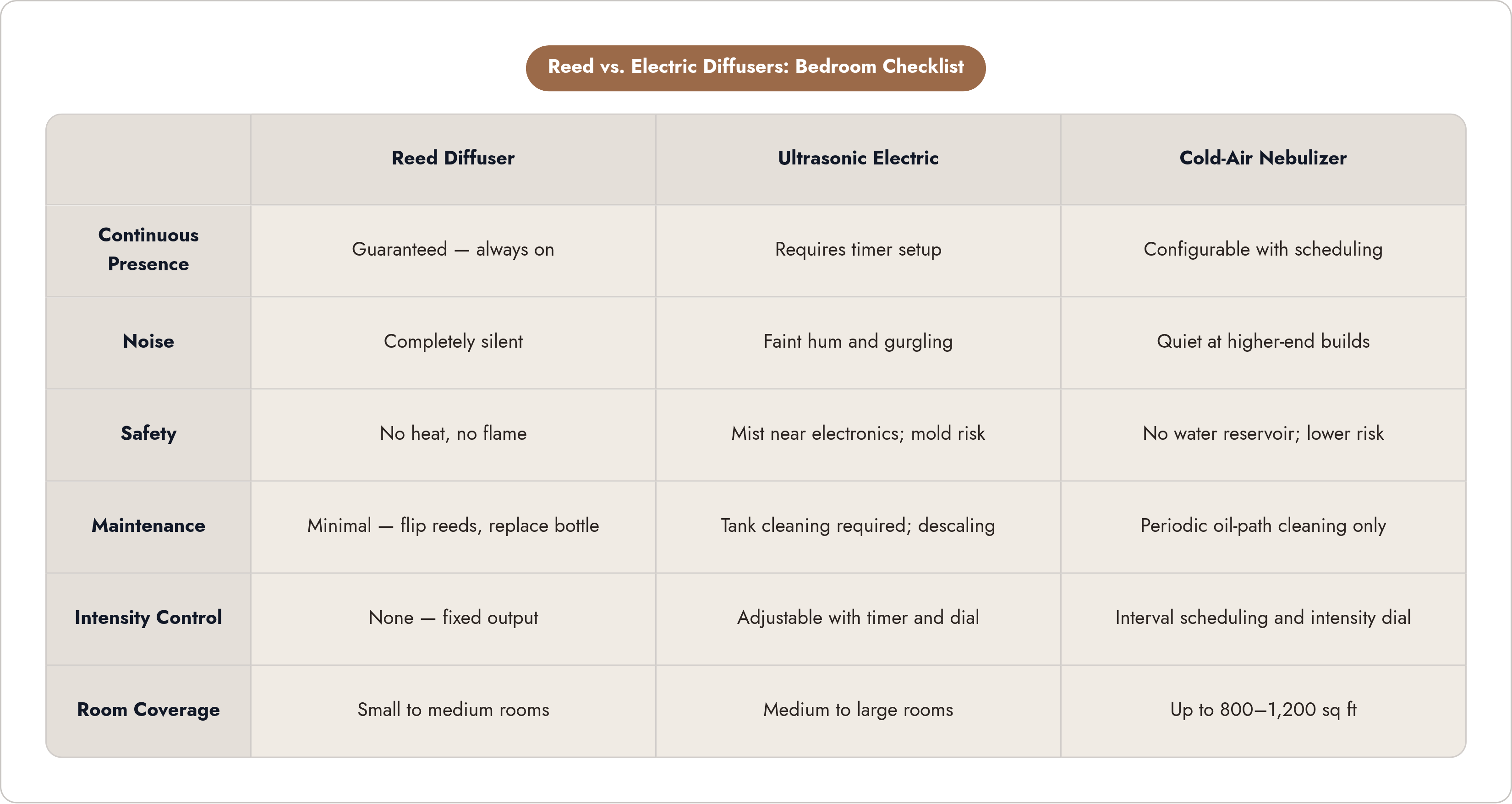
Neither format wins across the board, and if you've read this far, you already have the four variables you need to make the call yourself: room size, noise tolerance, how much control you want, and how much maintenance you're willing to do.
Reach for a reed diffuser if your room is small to medium and a single bottle's steady output feels right for the space. It suits anyone who wants minimal interaction, few settings, no charging cord, no cleaning schedule, and for whom noise is a hard, non-negotiable constraint. It's also a good pick if what you actually want is ambient scent that's simply always there, not tied to any nightly ritual, plus the side benefit of a single elegant vessel on the dresser instead of a gadget with a cord.
Reach for an electric diffuser if your bedroom is large enough that passive evaporation can't cover the whole footprint, or if scent is part of a deliberate wind-down routine where you want 45 minutes of diffusion while you read and then silence. It's also a strong choice if you want control over intensity night to night, dialing back on evenings when you're sensitive to fragrance rather than being stuck with a fixed dose. For large primary suites or multi-zone layouts, a cold-air nebulizing diffuser covering 800 to 1,200 square feet from a single unit brings a level of consistency and control that neither a reed diffuser nor a standard ultrasonic unit can realistically match.
The honest conclusion is that this comes down to fit rather than a single winner. Matching a format's actual mechanics to the specific room you're trying to sleep in is the whole exercise, and now you've got the checklist to do it yourself.