Luxury Hotel Scents Recreated at Home
Cold-air diffusion is the hotel secret that actually works at home.
Hotel lobbies smell expensive because of hardware, and the hardware has a name: cold air diffusion. It's a delivery method built for hospitality budgets and hospitality ceilings, which is exactly why the gift shop candle never quite recreates the room you remember. Let's take it apart piece by piece: what hotels actually run, why it works on a chemical level, and whether any of it survives the trip down to a bedroom that isn't 15,000 square feet.
Walk into a well-run hotel and something feels calibrated, almost suspiciously so. The same note greets you whether it's your first stay or your fortieth, whether you're in the Chicago property or the Scottsdale one. Scent is one piece of a five-sense strategy, deployed alongside lighting, music, and the temperature of the marble under your shoes. Some properties license a fragrance house's existing blend. The bigger chains commission proprietary scents built with consultants, calibrated down to the parts-per-million, which sounds excessive until you remember these companies run hundreds of properties on the line.
There's a term for this: olfactory branding, the practice of tying a scent so tightly to a place that you can't smell one without picturing the other. The Westin's White Tea blend is the textbook case. It's been running through Westin lobbies since 1999, and returning guests reportedly identify it before they've even looked up at the chandelier, a quarter-century of consistent delivery doing exactly the one job it was built for.
Rarely is it one scent for the whole building, though. Lobbies lean floral and citrus, tuned to feel energizing the moment you drag your suitcase in off a delayed flight. Spas shift toward jasmine, lavender, peppermint, while guest rooms go warmer, sandalwood and white tea, something that reads as tranquil instead of transactional. Each zone gets its own emotional assignment, and the fragrance gets picked to clock in and do that specific job.
Here's the part that explains why this sticks with you for years afterward: scent reaches the brain's memory and emotion centers faster than sight or sound, wiring almost directly into the limbic system instead of routing through the slower, conscious processing a photograph has to go through. That's why, a decade later, in a completely different building, one whiff of some lobby blend detonates a memory of a childhood vacation you hadn't thought about in years. Sight fades first, sound goes next, and smell files itself under something closer to memory itself, stubborn and oddly precise.
So why doesn't recreating the hotel smell at home ever quite land, even once you track down the exact fragrance oil, or that "inspired by" candle sitting near the gift shop register? I spent an embarrassingly long time assuming the oil itself was the problem, comparing note lists against whatever I remembered from some lobby years prior. That turned out to be the wrong thread entirely, since most copies get the notes close enough to fool a blind test. The delivery is where things fall apart, and that gap is the actual subject here.
How hotels actually deliver scent throughout a building
Hotels run a professionally installed system, tucked into the HVAC or mounted near the ceiling, quietly doing its job while nobody clocks the hardware. You won't find a candle sitting in the lobby, and you also won't find a diffuser bundled in with some humidifier from the drugstore aisle.
The technology is cold air nebulizing diffusion. It takes fragrance oil and shreds it into an extremely fine, dry mist using high-velocity air, skipping past the heat and water involved in slower methods.
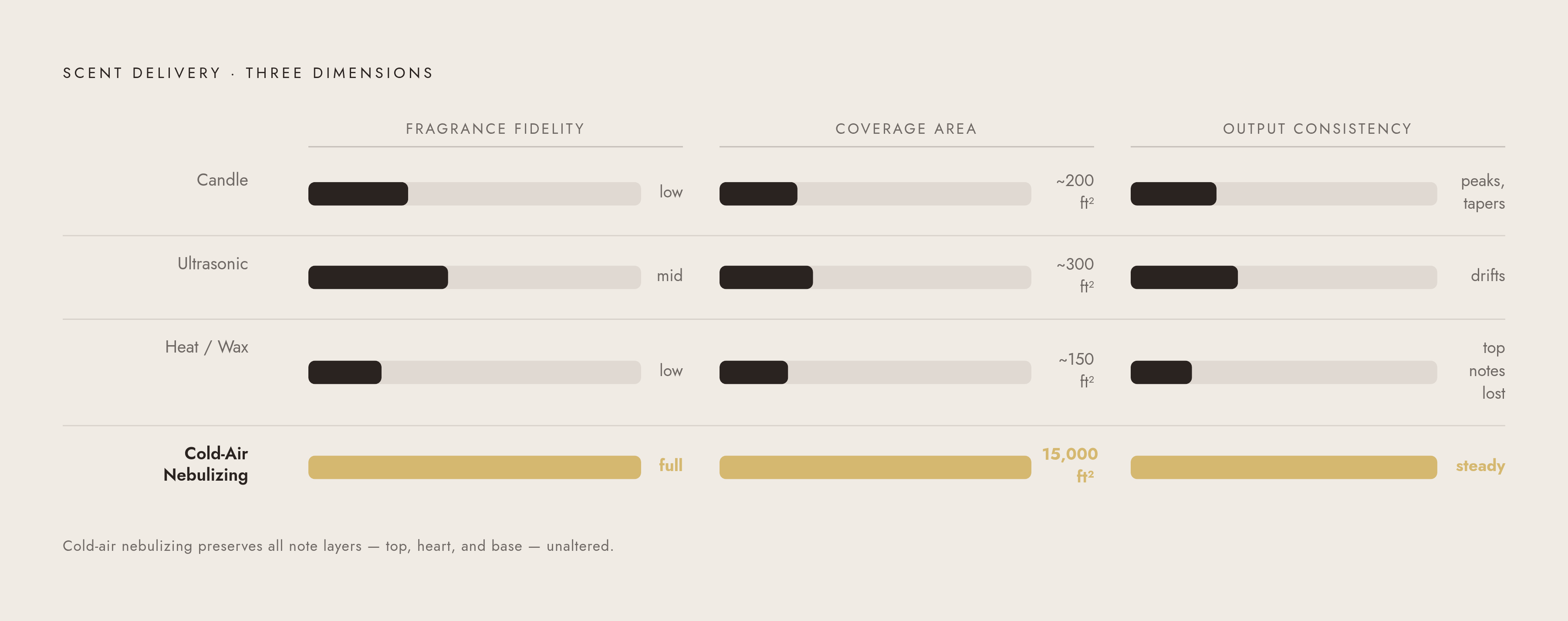
Why did the whole industry converge on this at scale? Heat and water both alter fragrance chemistry before it ever reaches your nose, so anything warmed or diluted arrives changed from whatever the perfumer originally built on the bench. Cold air skips that step, and the profile leaving the diffuser stays close to the one that was actually designed. It disperses evenly across large spaces instead of settling onto furniture, and it holds steady output hour after hour in a way a candle structurally cannot manage; a candle's scent throw peaks early and tapers as the wax pool widens, getting weaker exactly when you've stopped noticing it was ever strong.
The scale surprises people every time. Commercial cold-air units built for hospitality, the same class feeding scent through a corridor system, cover spaces up to around 15,000 square feet from a single unit tied into the building's air handling. That's infrastructure first, hotels and casinos first, miniaturized for the rest of us only later.
This is where the home experience usually goes sideways. Someone smells the Westin lobby, finds a candle or a water-based ultrasonic diffuser claiming the same notes, lights it up at home, and waits for the feeling to arrive. The fragrance DNA might genuinely be close, but the delivery mechanism almost never matches, and the result lands flatter, less "there." Once you know what's missing, the fix is straightforward, because the same cold-air nebulizing tech hotels built their reputation on now ships in home-sized units too.
What cold air diffusion does differently from water-based and heat-based methods
Take the usual home alternatives one at a time. Each one fails for its own specific reason, and the reasons matter more than just being told cold air wins by default.
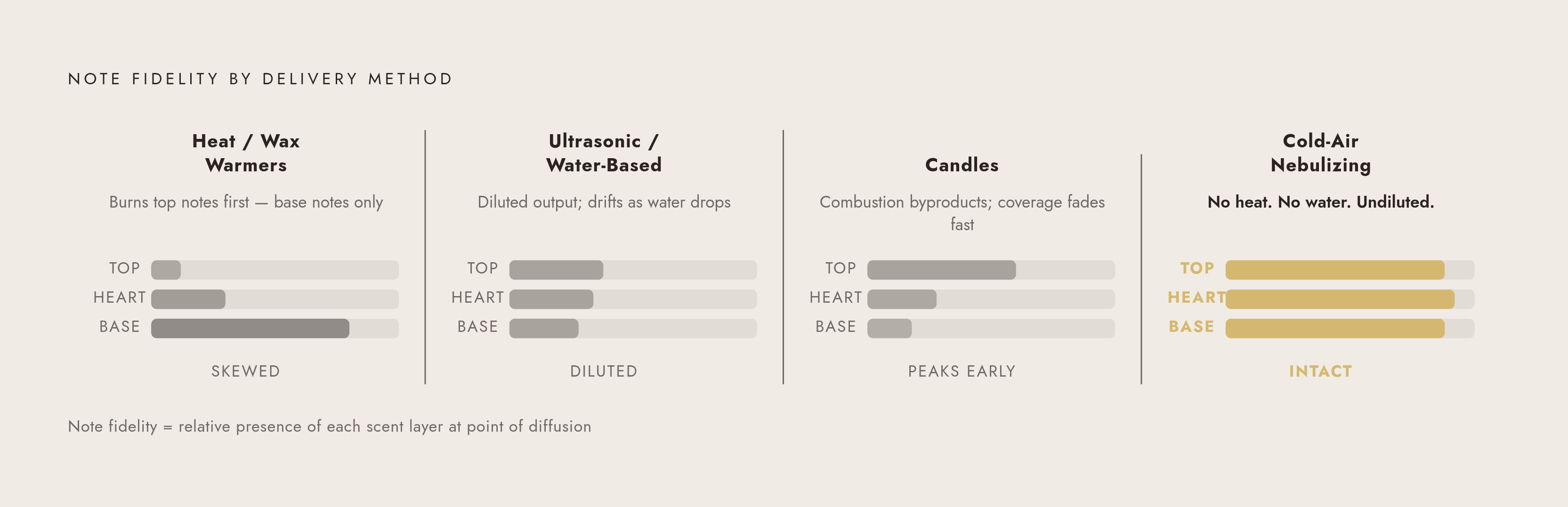
Ultrasonic and water-based diffusers dilute the oil with water before it ever reaches the air; that's the whole mechanism, vibration turning a water-oil mix into vapor. Two problems follow: added humidity can encourage mold over time, especially in bathrooms or poorly ventilated bedrooms, and scent output drifts as the water level drops, so hour one smells nothing like hour four.
Heat diffusers and wax warmers fail differently. High temperatures burn off the most volatile compounds first, and those happen to be the top notes: the bright citrus, the light floral opening act. Lose those early and what's left behind is heavier, flatter, and keeps shifting the longer it runs. You start with bergamot and lemon and, an hour later, you're mostly smelling base notes that had nowhere else to go.
Candles carry their own baggage: an open flame, combustion byproducts riding shotgun with the fragrance, coverage that rarely clears the room it sits in, and a scent throw that actually shrinks as the room warms around it.
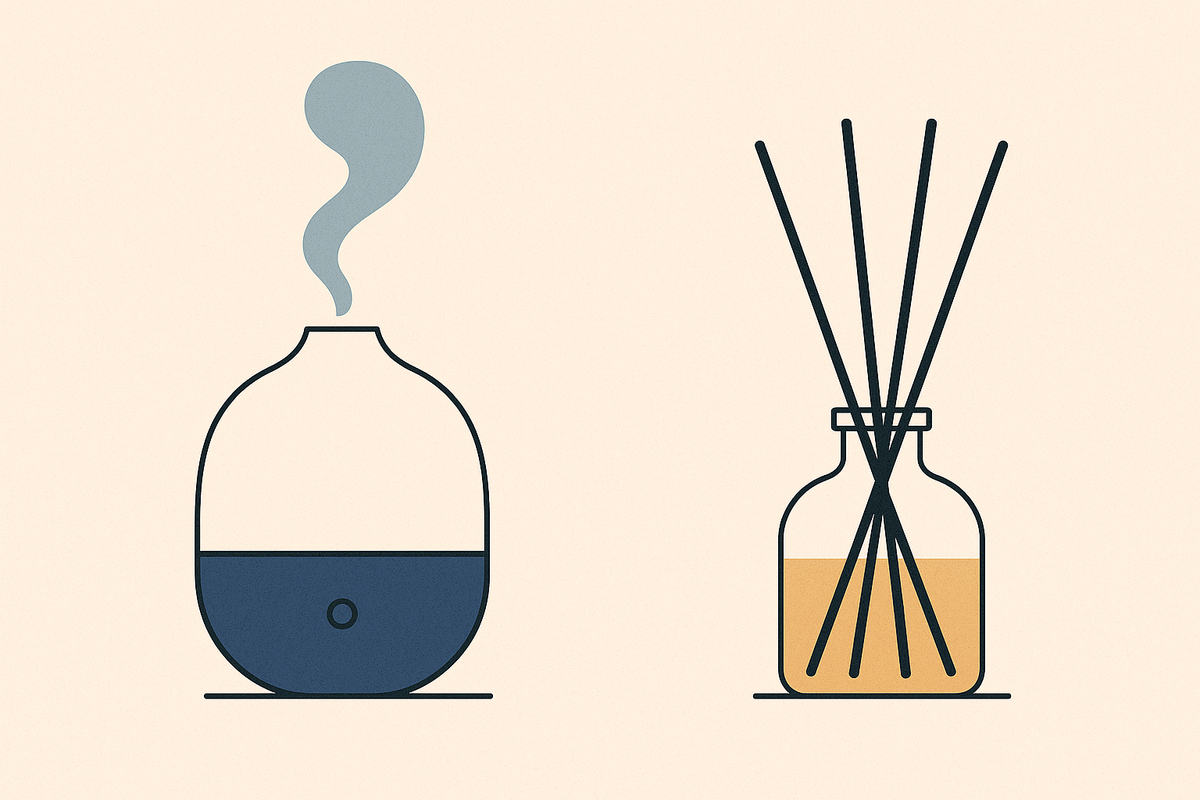
Cold air diffusion sidesteps these issues by never touching the oil with heat or water. The oil goes in undiluted, and high-velocity air atomizes it into a dry micro-mist that stays suspended instead of falling to the floor or clinging to the curtains. Manufacturer comparisons in this space put cold-air diffuser coverage at roughly double a typical candle, reed diffuser, plug-in, or ultrasonic unit, which tracks with what hotels have known for decades. This hardware was built for coverage rather than for a nightstand.
The fidelity difference is what actually matters to your nose, though. Because no heat touches the oil, top notes, heart notes, and base notes arrive in something close to the proportions the perfumer intended, layered instead of collapsed into one flat impression. That layering is exactly what gives a hotel lobby its "something sophisticated is happening here" quality, even if you couldn't name a single note under interrogation.
There's a safety angle too, since these units run for hours at a stretch. No open flame, no added humidity, no exposed heating element. Waterless cold-air diffusion is specifically called out as safe to run around kids and pets, which matters if the device lives in a house with a toddler who touches everything within reach or a dog that treats every appliance as a chew toy audition.
On running cost: at moderate intensity, 8 to 10 hours a day, a single 500 ml bottle of fragrance oil typically lasts 30 to 60 days. Worth knowing before you buy, if only to see whether it beats the candle habit it's replacing, both in dollars and in how many times you have to remember to restock wax melts you'll inevitably forget about.
The fragrance formulations hotels choose and why they translate well to cold air
Hotels generally aren't diffusing pure essential oils. They use fragrance oils formulated specifically for consistent output, broad appeal, and stability inside hardware running continuously. Essential oils vary batch to batch depending on the harvest; a fragrance oil built for a diffusion system skips that problem entirely, which matters a lot when the goal is guaranteeing the same smell in Miami and Seattle on the same Tuesday afternoon.
Here's a detail that doesn't get discussed enough: what you diffuse matters just as much as how. An oil loaded with phthalates, parabens, or high VOC content behaves very differently in a nebulizing diffuser than in a candle. A candle burns those compounds off, for better or worse, while a cold-air diffuser atomizes the oil directly into the room's air, undiluted, so whatever's in the bottle is what you're breathing for the next eight hours straight. That's reason enough to care about formulation. IFRA-certified, cleanly formulated oils are the right match for this hardware, both for how the scent performs and for what you're comfortable running in a bedroom night after night.
Consumers seem to have caught onto this too. The clean fragrance market was valued at $13.64 billion in 2025 and is projected to reach $33.40 billion by 2035, a compound annual growth rate of roughly 9.37%, according to Metatech Insights, making it the fastest-growing segment in home fragrance right now by a wide margin.
So what are people actually chasing? A handful of named profiles keep coming up. The Westin White Tea family, white tea, bergamot, lemon, light florals, amber, musk, is still the reference point for "hotel arrival" scent, the one people mean when they say a place smells expensive. The Ritz-Carlton direction leans white tea, bamboo, and vanilla, lighter and more grounded, suited to a bedroom or a spa-style bathroom. The Edition Hotels profile goes drier and more architectural: black tea, cedarwood, bergamot, something that works from a morning meeting through an evening dinner without ever feeling out of place at either. And the 1 Hotel "Sherwood" direction, all nature-forward woodsy notes, landed as one of the top-selling hotel-inspired home fragrances in 2025.
These multi-note profiles pair well with cold-air delivery for the reason covered above: complexity survives the trip. A three-stage scent, bright opening, floral or spicy middle, warm base, doesn't collapse into one flat note the way it does over heat. Oils formulated with that layering in mind are built to work with nebulizing diffusers rather than just tolerate them. That's a different design goal than an oil made for a warmer, and you notice the difference the moment you smell the two side by side.
Matching the right cold air diffuser to the room you want to scent
The most common mistake, by a wide margin, is buying a diffuser based on how it looks on a shelf instead of the square footage it's actually rated for. Undersized for the room, it underperforms no matter how good the oil is. Oversized, and it'll overwhelm a small bedroom in twenty minutes flat, turning what should be subtle into something closer to a perfume counter ambush.
Hotels don't make this mistake, because they can't afford to. Lobby units, corridor units, and guest room units all carry different specs, sized to the actual volume of air each one is responsible for. The same logic applies at home, just at a smaller, more forgiving scale where nobody's filing a complaint with corporate if it goes wrong.
For a bedroom, bathroom, or home office, a compact cold-air unit rated for that room's square footage does the job without turning the space into a department store fragrance counter. Over-diffusing a small room is, somewhat counterintuitively, just as disruptive as under-diffusing a large one; both leave you noticing the machine instead of absorbing the mood it's supposed to create. Open-plan living areas need either a higher-output unit or smart placement near the room's air return, since one small diffuser stuck in a 600-square-foot open kitchen-living space is fighting a battle it has already lost. For full-home coverage, HVAC-integrated cold-air systems scale up to entire residences: same technology class running through hotel corridors, just resized for a house.
Placement affects performance no matter the unit's size, and people tend to under-think this part badly. Put the diffuser near natural airflow paths so the mist travels with air movement instead of fighting it head-on. Elevated placement, a shelf or a console, lets the micro-mist drift down and spread out rather than sinking straight to the floor near the unit and never making it across the room. Keep it away from direct HVAC vents too, since those will just exhaust the scent outside before it gets the chance to fill the space it was meant for.
Intensity control matters more than people expect going in. A well-designed cold-air diffuser lets you dial output to match the room, and more fragrance isn't automatically better; the hotel standard is presence, not saturation. Running the unit on a schedule, before guests arrive, during a morning routine, during the evening wind-down, cuts oil use and prevents nose fatigue. Hotels use the same occupancy logic when they scent a lobby heavier during check-in hours than at 3 a.m., when the only person smelling it is the night manager.
Bringing the full hotel scent ritual into the home
What a hotel actually delivers is a consistent, zone-specific atmosphere that eventually stops registering consciously and just becomes the emotional wallpaper of the stay. You stop smelling the lobby by day two, and you just feel like you're somewhere nice, without always being able to say why.
Recreating that at home takes three things working together, and it took some trial and error on my end to see why all three actually matter instead of just one of them carrying the load. The right fragrance profile matters, obviously, and a cold-air delivery system that holds that fragrance steady over hours matters just as much. Placement that respects how you actually use each room ties the two together; skip that step and you've basically bought expensive furniture.
Zone-mapping is the practical version of this, borrowed straight from how hotels think about their floor plans. An entryway benefits from an arrival scent, citrus, light florals, or a fresh tea note, the same job the lobby scent does at check-in. The living room can carry something warmer and more complex, sandalwood, amber, woody base notes, built for sustained evening atmosphere rather than a quick hit on the way through. The bedroom should stay quieter: white tea, lavender, a muted musk, something reading as clean rather than assertive right before you fall asleep.
The consistency that makes hotel scent memorable is achievable at home precisely because cold-air diffusion holds output steady across hours instead of spiking and fading. Aromatherapy research published in the Public Health Policy Journal suggests that just 15 minutes of exposure to a well-diffused environment is enough to register a measurable mood shift, which says something about how little time this actually takes to work, and how much of the effect comes from steady delivery rather than sheer intensity.
Scent has become the finishing layer of a room in a way that used to belong exclusively to hospitality design. Hotel marketers sometimes call it the invisible final flourish, and that language has migrated into home design coverage under the banner of "scent styling," treating fragrance as a design decision on par with lighting or paint color. It's a small shift in framing, but one that mostly holds up under scrutiny, once you notice how much attention people already pay to how a room looks versus how it actually smells.
That reframing changes what kind of purchase a diffuser actually is. It delivers an experience daily, for months, rather than burning down and vanishing the way a candle does. Worth remembering if you're shopping for someone else and want to give something that outlasts the wrapping paper by a fair margin.
This brings things back around to where they started, more or less on purpose. Luxury hotels smell the way they do because someone invested in a delivery system built to hold a fragrance's full complexity, hour after hour, room after room. That system used to require a hotel's budget and a hotel's ceiling height to justify. It doesn't anymore, and figuring out what actually changed is most of what this piece was for.