Best Essential Oil Diffusers for Home Use
Four diffusion methods power the market, each with vastly different trade-offs.

To understand the trade-offs, you have to start with the mechanism. Not the design, not the price point, not the customer reviews. The mechanism.
Four methods underlie nearly every diffuser on the market, and they are not interchangeable variations on the same idea. They are categorically different approaches that happen to share a product category.
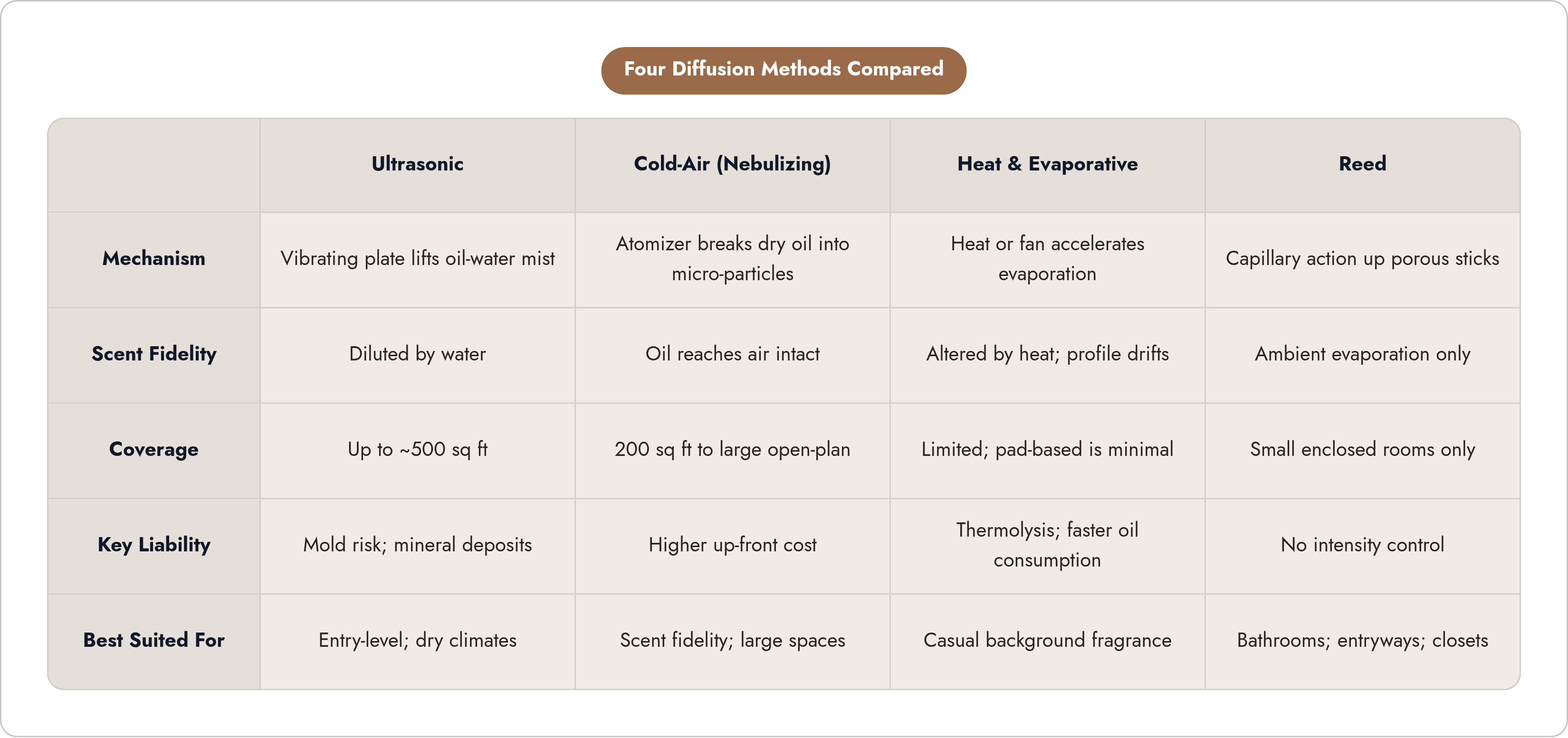
Ultrasonic diffusers use a piezoelectric plate that vibrates water at high frequency, lifting an oil-and-water mist into the air. The humidifying effect is inseparable from the scent output.
Cold-air, or nebulizing, diffusers use an atomizer to break liquid oil into microscopic dry particles, which room-temperature air then propels outward. No water, no heat, no dilution. The aromatic compounds reach the air chemically unchanged.
Heat and evaporative diffusers use warmth or a fan to accelerate oil evaporation. Faster volatilization means lighter top notes disperse first and heavier base notes linger, so the scent profile shifts throughout the session rather than remaining true to the blend.
Passive reed diffusers draw oil up porous sticks via capillary action. Release rate depends entirely on oil viscosity, room airflow, and ambient temperature. No power required, no user control over intensity.
The mechanism determines everything downstream: what the oil smells like once airborne, how far the scent travels, how much oil is consumed, and what can go wrong. Each method is a different tool that happens to share a category name, and the multibillion-dollar market built around them obscures that distinction more often than it clarifies it.
What ultrasonic diffusers do well and where they fall short
Ultrasonic diffusers command the largest segment of the market, which makes them the default choice for most first-time buyers. The reasons are practical: whisper-quiet operation, run times up to ten hours on a single fill, automatic shut-off, coverage of spaces up to roughly 500 square feet, and accessible price points. For many use cases, they are genuinely adequate.
But the water requirement is both a feature and a liability. That added humidity is useful in dry climates. In already-humid rooms, or for allergy sufferers, it compounds the problem rather than solving it.
More critically, oil is diluted in water before dispersal, so the concentration reaching the air is a fraction of what was added to the reservoir. Standing water introduces a mold and bacteria risk if the unit is not cleaned consistently. Mineral deposits from tap water can clog the vibrating plate over time. The scent experience is softer and more diffuse than the oil itself, which is useful for subtle background fragrance and limiting for larger rooms or anyone who wants a defined scent presence.
Some buyers want exactly that subtlety. Fair. But softer scent output is a consequence of the method, not a tunable setting.
Ultrasonic suits buyers who want an entry-level device, tolerate regular cleaning, live in dry climates, and are not chasing maximum oil fidelity. For everyone else, the question is what exactly they are trading away, and whether they know they are trading it.
Heat and evaporative diffusers: where they fit and what they cost the fragrance
Heat diffusers and evaporative diffusers are the oldest approaches in this category: electric warmers, wax melts, candle-heated dishes, fan-driven pads, car-vent clips. Simple, inexpensive, widely available. Also the most chemically disruptive to the oils they disperse.
Heat triggers thermolysis, the chemical breakdown of volatile organic compounds that give an essential oil its character. The aroma reaching the room is not the original blend. Lighter molecules escape first, heavier ones later, and the scent shifts throughout the session. Heating essential oils can also elevate VOC emissions and produce potentially irritating by-products.
Fan-evaporative models avoid heat degradation but offer no atomization. Oil evaporates passively from a pad, resulting in uneven release and negligible coverage for larger spaces. Both methods consume oil faster than cold-air alternatives because they rely on phase change rather than mechanical atomization of intact particles.
For casual, low-commitment applications where the goal is mild background scent and simplicity of operation, these trade-offs are acceptable. But anyone treating home fragrance as a considered purchase will find these methods inadequate. The trade is fragrance fidelity for convenience, and it is worth making that trade knowingly.
Reed diffusers: the case for passive fragrance and its real limits
Reed diffusers require no power, no cleaning, and no maintenance beyond an occasional stick flip. In 2025, reed diffuser sales grew faster than candle sales by a notable margin, which signals genuine consumer appetite for low-effort, always-on fragrance.
There is no intensity control; output is fixed by oil viscosity, stick count, and ambient conditions. Coverage is limited to small, enclosed areas. An open-plan room is effectively out of range. The fragrance profile is whatever the oil delivers at ambient temperature, with no atomization and no consistency guarantee across seasons or climates.
Reed diffusers are excellent accent fragrance sources in bathrooms, entryways, and closets. The mistake is positioning them as a primary home scent solution when the physics simply do not support it. A reed diffuser in a 400-square-foot living room is not a home fragrance strategy. It is optimism.
Why cold-air diffusion delivers a different quality of scent
Essential oils contain hundreds of volatile organic compounds. Those structures are fragile. How a diffuser handles them determines whether what enters the room resembles what was in the bottle.
Cold-air atomization breaks oil into a dry micro-mist at room temperature: no heat, no water, no alcohol. The compounds reach the air intact. That is not a marginal improvement over other methods; it is a structural one, rooted in what the mechanism does not do to the oil.
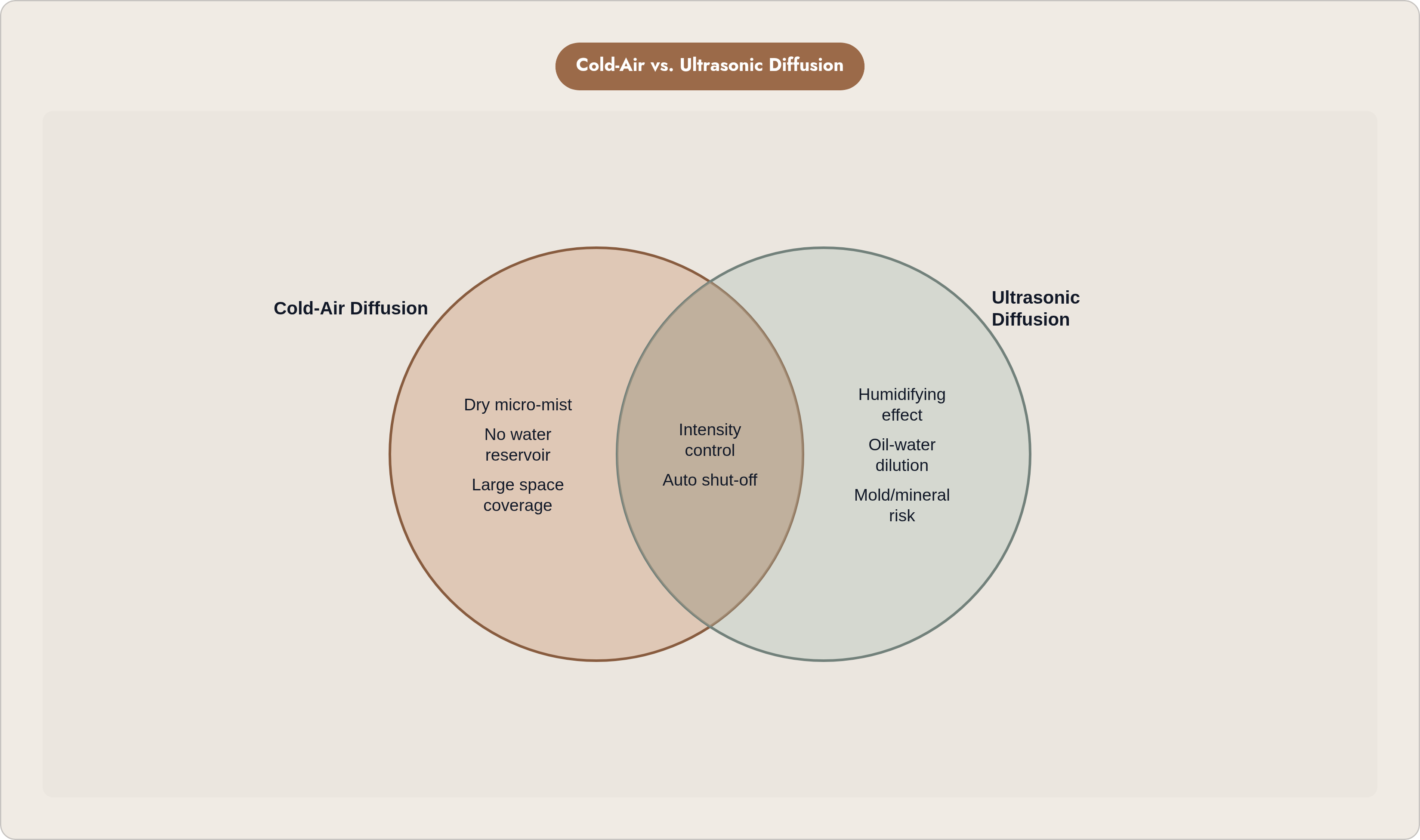
Against ultrasonic, cold-air diffusion eliminates water dilution, the moisture variable, and mold risk in the reservoir. Against heat diffusion, it eliminates thermolysis, by-product formation, and scent-profile drift. Against reed diffusers, it substitutes active atomization for passive evaporation, which means controllable intensity and substantially broader coverage.
That coverage advantage is significant. Personal cold-air units typically handle 200 to 500 square feet; higher-output units cover spaces well into the four-digit square-footage range. The scent experienced is the oil as formulated, not a watered-down, heat-altered, or passively evaporated approximation of it.
This is why cold-air diffusion is the method most associated with luxury hotel scenting programs. Whether it is the right standard for a given buyer is a separate question, and a fair one. But it helps to know the standard exists before settling for less.
Oil efficiency and running costs across diffusion methods
Cold-air atomization uses a small number of drops of oil to fragrance a room for several hours, doing so more economically than water-based or heat-based diffusers, which require meaningfully larger volumes to produce comparable scent intensity.
The gap exists for a straightforward mechanical reason. Ultrasonic disperses a diluted oil-water mixture, so a larger volume of liquid is required to produce equivalent output. Heat and evaporative methods volatilize both aromatic and non-aromatic compounds non-selectively. Cold-air atomizes only the oil, intact, with nothing lost to dilution or thermal degradation.
One wellness practitioner cited a 70% reduction in monthly oil consumption after switching to cold-air diffusion, with stronger and longer-lasting results, estimating annual savings of $200 to $400 on oil alone. That is the kind of number that changes the math on the higher up-front cost of a cold-air unit fairly quickly.
Smart scheduling amplifies the advantage. Timed on/off cycles prevent continuous running and reduce consumption without sacrificing scent presence when it matters. The up-front cost of a cold-air unit is real. The total cost of ownership, factoring in oil consumption over months of regular use, frequently tells a different story.
Matching diffuser type to room size and layout
Coverage figures only matter if they reflect real-world conditions. A diffuser rated for 500 square feet in an open-plan space will underperform in a room with high ceilings, poor air circulation, or heavy soft furnishings that absorb fragrance before it disperses.
Performance in a given room is governed by the interaction between the diffuser's output capacity, the room's geometry, and its airflow patterns. Those three variables are rarely considered together at the point of purchase.
For small, enclosed rooms up to roughly 200 square feet, a personal cold-air unit or a well-maintained ultrasonic works adequately. Reed diffusers suit bathrooms as passive accents. For mid-size living rooms and open-plan areas in the 200 to 500-square-foot range, cold-air diffusers at the personal-to-mid tier are the more reliable performers; ultrasonics struggle to project scent evenly without multiple units. For large open-plan spaces or whole-home coverage, higher-output cold-air units or strategically placed multiple units are the practical solution.
Placement matters regardless of method. Position diffusers at mid-height, not on the floor; fragrance particles disperse downward with gravity. Proximity to an air circulation path, such as an HVAC return or a doorway, aids even distribution, but direct airflow onto the diffuser head dissipates scent before it spreads. Avoid corners and enclosed shelves.
A diffuser that is underpowered for its room will tempt the user to run it continuously or add excess oil. Both problems are solved by choosing the right type and output level at the outset. Matching a cold-air diffuser to its stated square footage is the most reliable starting point for consistent performance.
Fragrance oil quality and what it means for every diffusion method
The diffusion method determines how much of an oil's chemistry survives the journey into the air. The oil's formulation determines what that chemistry actually is.
Conventional plug-ins and some synthetic fragrance products present a transparency problem: "fragrance" on a label can represent dozens of undisclosed individual chemicals, and phthalates are a documented concern in many formulas. BPA-free construction and non-heated operation reduce the risk of plastic off-gassing, which is relevant for any diffuser type but especially for devices that run for hours daily. In January 2025, the U.S. FDA issued updated guidelines mandating clearer health disclaimers and usage directions on essential oil labeling, a signal that ingredient transparency is becoming a regulatory expectation rather than a consumer preference.
Cold-air diffusion's no-heat, no-water mechanism means a clean oil arrives in the room as formulated. But a poorly sourced oil still delivers its problems intact. The method amplifies both quality and deficiency in equal measure.
Aura House fragrance oils are formulated to be clean, vegan, and cruelty-free, designed specifically for cold-air diffusion so the technology and the oil function as a matched system rather than two independent variables. Whether a matched system matters depends on how seriously a buyer takes the underlying chemistry. But it helps to know it exists.
Smart features worth having versus features that add complexity without value
Nearly half of diffuser buyers are already seeking models with advanced functions. That demand is real, but not every smart feature solves a real problem.
The features that meaningfully improve the experience are fairly simple. Scheduling prevents over-diffusion, reduces oil waste, and ensures scent is present when it matters: a morning routine, a pre-sleep wind-down, a period of heavy foot traffic through the entryway. Intensity control, the ability to dial output up or down without changing the oil, is essential for matching fragrance to a room's occupancy and purpose. A bedroom at 10 p.m. does not need the same output as an open-plan kitchen at noon.
App connectivity adds real value when it makes scheduling and intensity control more accessible. It adds complexity without value when it requires a working internet connection to operate a basic function. Auto-shutoff timers are a meaningful safety and efficiency feature. Color-changing LED modes are not.
The technology that matters most in a diffuser is the one that determines scent quality, and that decision happens at the mechanism level, not the feature level. A cold-air diffuser with a simple timer outperforms, in every measurable fragrance dimension, a feature-laden ultrasonic with app control.
The most effective feature a diffuser can have is the right atomization method for the room it is in. Everything else is configuration.